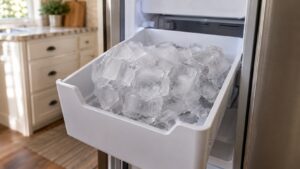
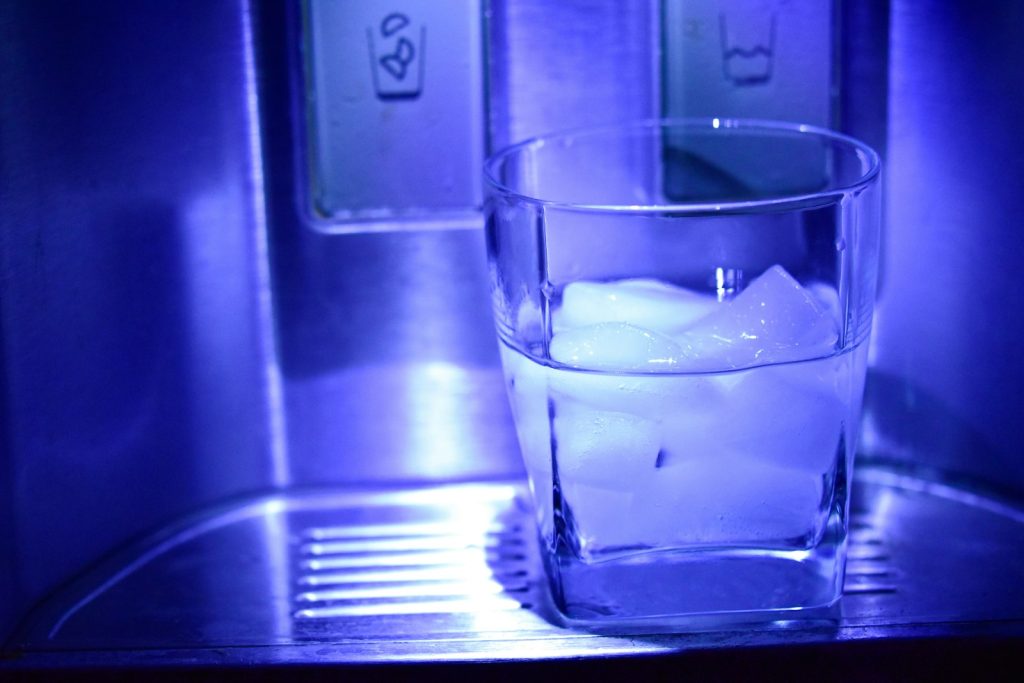
A Samsung ice maker is not a standalone appliance with its own control board — it is a subassembly wired into the refrigerator’s electronics. That matters for diagnostics: when something goes wrong with ice production, the error code (if one appears) shows up on the fridge display and comes from the shared refrigerator control board, not a dedicated ice maker chip. This guide is written for independent appliance technicians and is not affiliated with Samsung.
Codes that relate to the ice maker
Samsung refrigerators, freezers, and ice makers share one control-board code family. The codes most often tied to ice production trouble are 8E and 14E (ice maker sensor failures), 33E (ice pipe heater malfunction), and 39E (ice maker fan error). You may also see 40E, which points to the ice room fan rather than the maker itself. If your unit displays 88 88 after a power interruption, that is a communication reset code, not an ice maker problem — let the unit run a normal cycle before assuming a part failed.
Common symptoms and likely causes
- No ice at all: check for a frozen or kinked water supply line first, since this is the single most common cause. A clogged inline water filter is the second most likely culprit — most Bespoke and Family Hub models flag filter age on the display, but the filter can still restrict flow before that warning appears.
- Small, hollow, or misshapen cubes: usually low water pressure at the supply valve, a partially frozen fill tube, or a failing water inlet valve rather than the ice maker module itself.
- Ice maker runs but nothing drops into the bin: look at the ejector motor and the ice maker’s internal thermistor — an 8E or 14E code strongly suggests a sensor or motor problem here.
- Ice tastes stale or the bin frosts over: often a door seal issue letting warm humid air into the freezer compartment, or a fill tube dripping and refreezing between cycles rather than a component failure.
- Dispenser won’t release ice: check the dispenser flap solenoid and auger motor before replacing the ice maker assembly.
Diagnostic steps before calling a technician
Start by confirming the freezer compartment itself is reaching temperature — an ice maker cannot function if the surrounding freezer air is too warm, and that points to a sealed-system or defrost problem rather than the ice maker. Next, pull and inspect the water filter; a filter overdue for replacement restricts flow enough to slow or stop ice production long before it triggers any warning. Check the supply line at the shutoff valve behind the refrigerator for kinks or ice blockage, and confirm the freezer door is sealing fully, since even a partial seal failure will frost the ice maker’s fan and sensor.
If you have already ruled out the filter, supply line, and door seal and are still seeing an 8E, 14E, 33E, or 39E code, the ice maker module or its wiring harness likely needs professional evaluation. Because the ice maker shares the fridge’s control board, a technician diagnosing one of these codes will typically check the whole cooling and electrical system rather than swap the ice maker assembly in isolation — this avoids replacing a part that was never actually responsible.
When to schedule service
Persistent error codes, a freezer compartment that will not hold temperature, or an ice maker that has been unplugged and reset without improvement are all signs the problem is beyond a filter change or a thawed line. Our technicians work on Samsung refrigerator and ice maker assemblies daily and can pinpoint whether the fix is a sensor, a fan motor, or a sealed-system issue before any parts are ordered. See our ice maker repair service page for scheduling, or review Samsung’s own support documentation at samsung.com/us/support for filter part numbers specific to your model.
This guide is provided by an independent appliance repair service and is not affiliated with, endorsed by, or sponsored by Samsung Electronics.