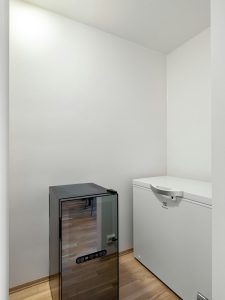

A standalone Samsung freezer doesn’t ask for much, but the small amount of attention it does need is easy to skip since it’s usually tucked away in a garage or basement out of daily sight. A quarterly check-in prevents most of the common failures — frost buildup, weak seals, and airflow problems — that otherwise sneak up over months of running unattended.
Check the door seal regularly
Because standalone freezers are opened far less often than a kitchen refrigerator, a weakening gasket can go unnoticed for a long time. Run your hand around the door seam while the unit is running and feel for cold air escaping, or close the door on a dollar bill and check whether it slides out easily. A compromised gasket is one of the most common causes of heavy frost buildup and a freezer that runs constantly without ever quite catching up.
Defrost manual units on a schedule
If your freezer isn’t a frost-free model, ice buildup on the interior walls is normal, but it needs to be kept in check. Once frost gets thicker than about a quarter inch, it acts as insulation and makes the compressor work harder to reach the same temperature. Plan on a manual defrost once or twice a year — unplug it, prop the door open, and let the ice melt with towels down to catch the water, rather than chipping at it, which risks puncturing the evaporator coil.
Give it room to breathe
Freezers pushed tight against a wall or crammed into a corner don’t have enough clearance for the condenser coils and fan to dissipate heat properly. Leave a few inches of space on the sides and back, and make sure nothing is stacked on top blocking any vents. This is especially relevant in garages and basements where freezers often end up wedged next to shelving or storage bins.
Keep it reasonably full, but not packed solid
A freezer that’s mostly full actually holds temperature more efficiently than one that’s nearly empty, since the frozen contents act as thermal mass. That said, packing it so tightly that air can’t circulate between items forces some areas to run warmer than others. Leave small gaps between bags and containers rather than stacking everything flush against the walls.
Watch the room temperature around it
Standalone freezers in unheated garages or sheds work harder in extreme summer heat and, on some older models, can struggle in very cold winter conditions if they’re not rated for low ambient temperatures. If your unit is somewhere that swings widely with the seasons, it’s worth checking the manual for the manufacturer’s recommended ambient range and keeping an eye on performance during temperature extremes.
Listen for changes in normal operating sound
Most freezers settle into a predictable rhythm of compressor cycles, clicks, and fan hum once they’ve been running in place for a while. A new rattling noise, a compressor that seems to run continuously without ever cycling off, or unusual clicking without the compressor actually starting are all worth noting. These changes often show up well before a freezer stops cooling altogether, and catching them early tends to mean a smaller, cheaper repair than waiting until the unit fails outright.
When maintenance isn’t the answer
Good habits keep a healthy freezer healthy, but they won’t restore a failed fan motor or a compressor that’s lost its charge. If you’re doing everything right and still seeing excess frost, warm spots, or a unit that’s stopped cooling, it’s time for an actual inspection. Our freezer repair service can pinpoint the cause, and Samsung’s support resources are available at Samsung Support.
This guide is provided by an independent appliance repair company and is not affiliated with, endorsed by, or sponsored by Samsung Electronics.