
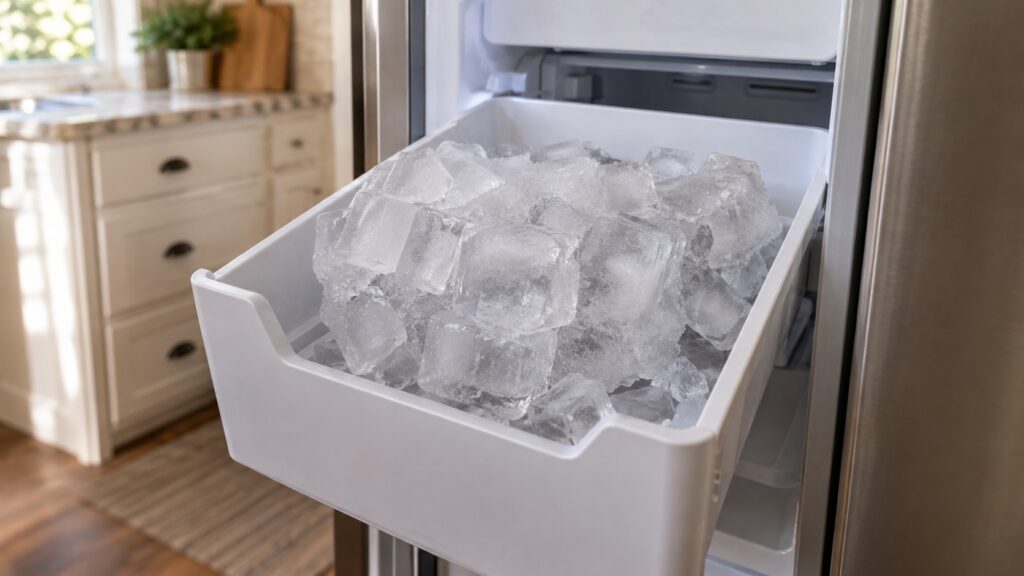
An ice maker that freezes into a solid block is not making ice badly — it is making ice and then failing to let go of it. When a samsung ice maker freezing up complaint arrives, the cause is almost always warm humid air reaching a compartment that should be sealed against it, and the fix is usually about air and seals rather than about the ice maker itself.
Why humid air is the whole story
An ice compartment is a small, very cold space. Room air holds water vapor, and when that air reaches a surface below freezing, the vapor deposits directly as frost. It does not need much air and it does not need long.
Once a film of frost exists on the mold or the bin, new ice lands on it and fuses. Cubes stop being separate objects and become a single block, the auger that should push them to the chute meets a solid mass, and the dispenser either jams or runs without delivering anything.
That is why the useful question is never “why is the ice maker broken” but “where is the warm air getting in”.
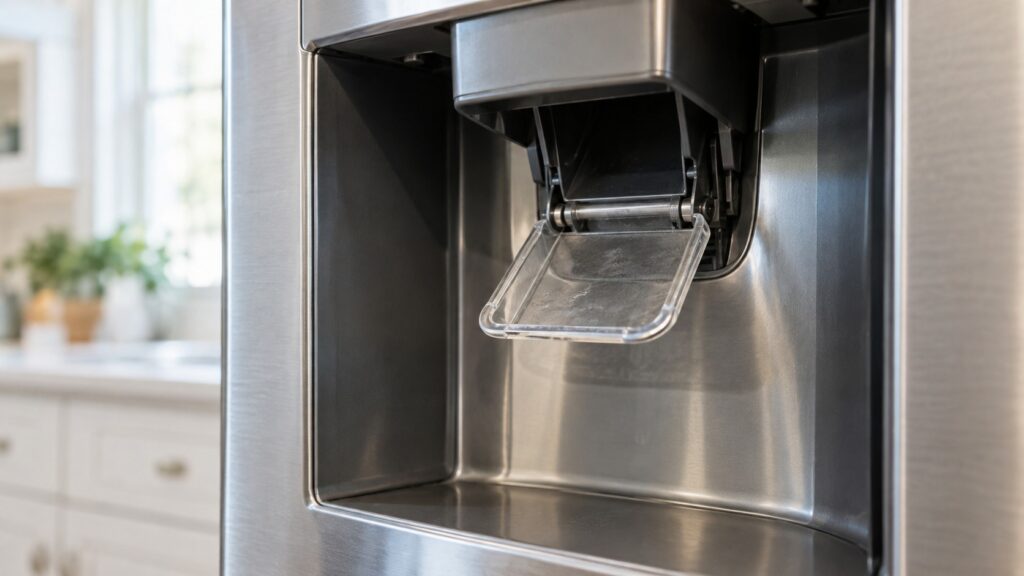
Check the chute flap first
The dispenser chute runs from the ice compartment through the door, and it is closed by a small flap at the outer end. That flap is the only thing between a freezing compartment and a warm kitchen, and it is held open by remarkably little.
Look at it directly. A fragment of ice on the seat, a piece of debris, a flap that has gone stiff, or a return spring that has weakened will all leave it fractionally ajar. Warm air then flows in continuously, twenty-four hours a day.
Clean the seat, check the flap moves freely and closes fully under its own return, and watch what happens over the following week. This single check resolves a large share of these calls.
Then the compartment seal and the door
The ice compartment usually has its own gasket where it meets the door or the liner. Inspect it for flattened sections, gaps at the corners, and residue holding it away from the surface.
Then check the main door itself. Close it on a banknote and pull at several points; it should grip everywhere. A door that is being held fractionally open by a full bin, a tall bottle or a shelf that is not seated does exactly what a failed gasket does.
French door models deserve a specific look at the center where the two doors meet, because that seal depends on a hinged flap that can stop sitting correctly. Our refrigerator maintenance guide covers the seal checks.
Thaw it properly before anything else
Do not chip at it. The mold, the fill tube and the evaporator behind the compartment are thin, and a punctured tube turns a housekeeping job into a sealed system repair.
- Turn off ice production at the control, and shut the water supply if you will be at it a while.
- Remove the bin and empty it. If it will not come out, do not force it — thaw first.
- Let it thaw with the door open, with towels down. Several hours is normal.
- A hair dryer on low, kept moving, speeds it up. Never a heat gun, never boiling water.
- Dry everything completely before reassembly. Residual water is next week’s frost.
- Restore ice production and discard the first two or three batches.
The causes that are not about air
If the seals are good and it still freezes up, work through these.
- Low ice use. Ice that sits for weeks slowly sublimates and refreezes into a mass. A household that uses little ice should empty the bin every few weeks regardless.
- Freezer running too warm. Counterintuitive, but a marginal freezer produces slow, wet harvests that fuse.
- A defrost fault. Frost building elsewhere in the appliance at the same time points here.
- Overfilling. A mold that fills past its level leaves water bridging between cubes, and the bridge freezes solid.
- A fill tube that ices. Water dribbling rather than filling cleanly produces a spike of ice up the tube.
The last two point at the water inlet valve or its pressure, and they usually come with malformed cubes as well as fused ones. Our ice maker troubleshooting guide covers those symptoms, and the error code diagnostics guide covers what the panel may be reporting.
Keeping it from coming back
Use the ice. That sounds trivial and it is the single most effective habit — ice in circulation does not sit long enough to fuse. Empty the bin completely every month or so if the household does not get through it.
Keep the chute flap clean, close the doors deliberately rather than letting them swing, and do not pack the freezer so full that a door cannot seat. Check the bin is seated correctly after cleaning, because a bin sitting proud holds the compartment open.
Humidity in the kitchen itself plays a part too. A refrigerator in a room where a dishwasher vents steam, or in a basement in summer, sees damper air at every door opening than the same appliance in a dry kitchen. It is not something you can change quickly, but it explains why one household has this problem twice a year and a neighbor never has it at all.
When to call
Call when the compartment ices up again within weeks of a full thaw with good seals, when the auger motor runs without delivering, when the fill tube ices repeatedly, or when frost is appearing elsewhere in the freezer at the same time.
We are an independent repair company and not a factory service arm. Pricing starts from a diagnostic visit and we confirm the estimate before any work begins. Samsung ice maker repair covers molds, augers, valves, seals and controls, and you can schedule a visit online.