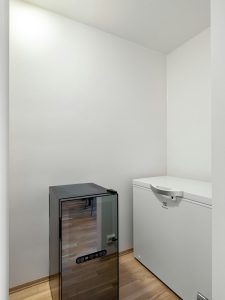

Standalone Samsung RZ freezers see a different set of installation issues than a built-in refrigerator, mostly because owners tend to place them in garages, basements, and utility spaces rather than a climate-controlled kitchen. A few checks up front can prevent a lot of frustration down the line.
Ambient temperature range
Every Samsung freezer is rated for a specific ambient temperature range, and running it well outside that range — a garage that drops near freezing in winter or climbs into the 90s in summer — can affect how the compressor and defrost cycle perform. In cold garages, the freezer’s internal thermostat can be fooled into under-running, leading to items in the front not staying frozen even though the unit seems to be working. If your freezer is in an unconditioned space and behaving inconsistently, this is worth checking before assuming a sensor has failed.
Leveling
Level the freezer front-to-back and side-to-side using the adjustable feet. An unlevel freezer can cause the door to not seal fully or to swing open on its own, letting warm air in that raises internal temperature and causes frost buildup around the gasket — a common cause of what looks like a cooling problem but is really a door-seal issue.
Clearance for airflow
Like refrigerators, standalone freezers need clearance around the back and sides for the condenser coil to dissipate heat properly. Freezers tucked tightly against a wall or into a narrow closet without the specified clearance run hotter and less efficiently, which can shorten compressor life and occasionally trigger fan-related codes (21E/23E) as the system works harder than it should.
Electrical supply and extension cords
Freezers should be plugged directly into a properly rated outlet — never through an extension cord or power strip, which can’t reliably supply the startup surge a compressor needs and is also a fire risk over the long run the freezer stays plugged in. If the freezer is on a circuit shared with other equipment in a garage or workshop, voltage fluctuations from that equipment starting up can cause intermittent low-voltage problems (85C) that look like a failing compressor.
Door gasket seating
On chest and upright freezers alike, check that the door gasket makes full contact around the entire frame when closed — a gasket that’s been pinched by items stored too close to the door, or that’s simply worn with age, lets in humid air that frosts up heavily inside. This is one of the most common “my freezer isn’t working right” complaints that turns out to be a seal issue rather than a mechanical problem.
Location and access for future service
When placing a standalone freezer, leave enough room around it not just for airflow but for a technician to eventually access the back panel if service is ever needed. Freezers wedged into a corner with the back permanently against a wall and no way to pull it forward make even a straightforward fan or sensor repair take considerably longer, since the unit has to be moved before any work can begin. A few extra inches of planned clearance at install time saves real labor time later.
When to call a technician
If the freezer is level, properly cleared, on a dedicated outlet, and the gasket seals fully but temperature or noise problems persist, it’s time for a proper diagnostic. Our freezer repair technicians check these installation basics first, and our freezer error code page covers what a specific display code means.
This guide is provided by an independent appliance repair service and is not affiliated with Samsung.