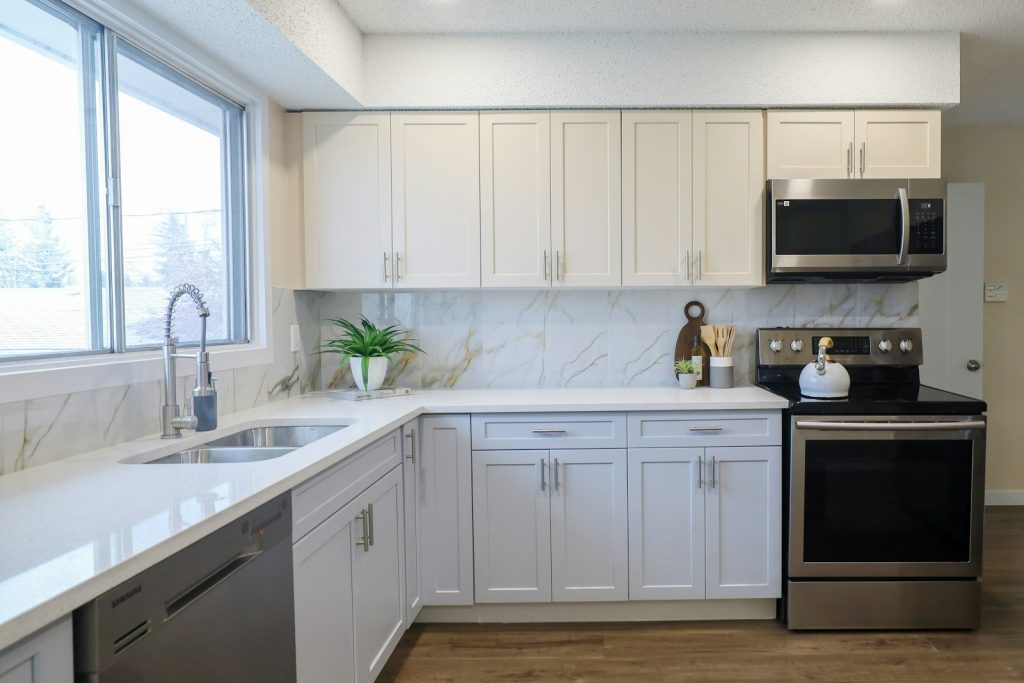
Samsung microwaves (ME countertop, MC combination microwave/convection, and MS over-the-range models) share a control code family with their own set of gas sensor, temperature, and door codes distinct from Samsung’s cooking range lineup. What a repair costs largely comes down to which of these subsystems failed. This guide is independent and not affiliated with Samsung.
What drives the cost of a microwave repair
- Over-the-range vs. countertop: MS over-the-range models double as a range hood with a built-in exhaust fan and light, adding components (fan motor, grease filter sensor, mounting bracket) that a countertop ME model doesn’t have.
- Combination convection models: MC models with a convection function add a fan motor and often a second heating element, which widens the range of things that can fail compared to a simple reheat-only microwave.
- High-voltage components: the magnetron, high-voltage capacitor, and high-voltage diode carry lethal stored charge even when unplugged, and any repair touching these should only be performed by a trained technician — this is not a component for DIY troubleshooting.
- Door switch assemblies: microwaves use multiple interlock switches for safety, and door-related codes often require replacing the switch assembly as a set rather than a single switch.
Repairs that are typically quicker
A failed turntable motor, a charcoal or grease filter replacement on an MS over-the-range unit, a door handle, or a light bulb/LED assembly are usually straightforward, well-documented repairs.
Repairs that take more diagnostic time
C-11 and C-12 codes point to the gas/PH sensor circuit, while E-11 through E-14 are a related gas sensor failure family — telling these apart from a genuine cooking performance issue takes some testing. C-20 through C-22 and E-21 through E-26 relate to temperature sensing, and E-31 through E-36 cover weight or door sensor failures on models with those features. Because several of these codes can overlap in symptom (microwave runs but doesn’t heat, or shuts off mid-cycle), a technician typically needs to test the actual component rather than rely on the code alone.
Communication and control codes
C-F0 through C-F2 and E-81 through E-83 indicate communication problems between the control board and display or keypad, and -SE- or a “TE” indicator points to a shorted or stuck touch key. These are often connector or keypad issues rather than full board failures.
Sensor-cook features and diagnostic nuance
On models with sensor-cook or auto-reheat functions, it’s worth distinguishing between the unit failing to cook food properly and the unit failing to heat at all. A gas sensor failure (C-11, C-12, E-11 through E-14) typically affects only the automatic sensor-based programs while manual power/time settings still heat normally, whereas a true magnetron or high-voltage failure means nothing heats regardless of the mode selected. Telling a technician which scenario you’re seeing narrows the diagnostic considerably before the visit even starts.
Getting an accurate estimate
Note the exact code, whether the unit is countertop, over-the-range, or a convection combo model, and whether the issue is heating, the door, the turntable, or the exhaust fan (for MS models). Visit our microwave repair service page to schedule a visit, or check Samsung’s documentation at samsung.com/us/support for your exact model.
A safety note
Never open the cabinet of a microwave to inspect internal components yourself. The high-voltage capacitor can retain a dangerous charge long after the unit is unplugged.
This guide is provided by an independent appliance repair service and is not affiliated with, endorsed by, or sponsored by Samsung Electronics.