A surprising number of Samsung refrigerator complaints — poor cooling, ice buildup, or repeat error codes — trace back to how the unit was installed and leveled rather than a failed part. Checking these basics can save an unnecessary service call.
Leveling and door alignment
Samsung RF and RS French-door and side-by-side models need to sit slightly tilted back (roughly a quarter to half inch higher in front than in back) so the doors swing closed and seal on their own rather than drifting open. Use the front leveling legs to make this adjustment. Doors that don’t fully seal let warm, humid air into the cabinet, which can cause frost buildup around the freezer door gasket and make the compressor run longer than it should, sometimes triggering fan-related codes (21E/22E/23E) as the system struggles to maintain temperature.
Clearance around the unit
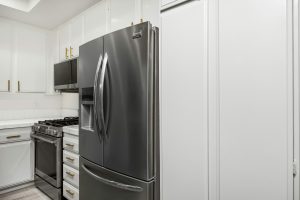
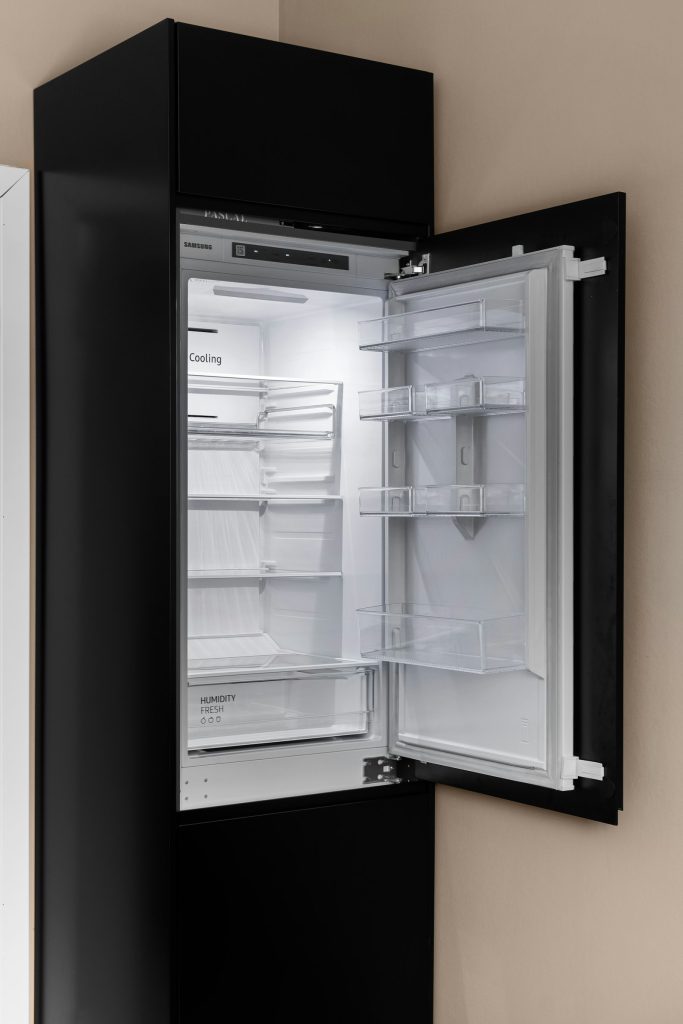
Samsung specifies minimum clearance on the sides, top, and back of the refrigerator for proper airflow across the condenser coil. A refrigerator pushed too tightly into a cabinet opening can’t dissipate heat effectively, which shows up as the unit running constantly, warmer-than-expected temperatures, or a compressor-related problem (84C/85C) from the system working harder than designed. If your install is in a tight cabinet enclosure, confirm it meets Samsung’s specified clearance rather than assuming any built-in-style opening will work.
Water line connection for ice and water
Models with a water/ice dispenser need a dedicated water line connected to the inlet valve at the back, with the shutoff valve fully open. A kinked line, a partially closed valve, or a clogged inline filter restricts flow to the ice maker and dispenser, which can present as slow ice production or a 33E ice-pipe-heater failure even when the heater itself is fine. Flush the line and replace the water filter per the schedule shown on the display before assuming a mechanical part has failed.
Electrical supply
Confirm the refrigerator is on its own outlet rated for its power draw, not sharing a circuit with other major appliances. An unstable or shared power supply can cause intermittent communication problems (PC ER/PC CH) or trigger the 88 88 display that normally only appears after a genuine power interruption. If you see 88 88 without a known power outage, check the outlet and circuit before assuming the main board has failed.
Ambient conditions around the kitchen
Refrigerators installed near a range, in direct sunlight through a nearby window, or in an enclosed nook without adequate ventilation work harder than one placed in a more neutral spot in the kitchen. This isn’t usually something you can change after the fact, but it’s worth knowing about if your unit seems to run more often than a similar model elsewhere in the house — it may simply be compensating for its environment rather than signaling a problem.
Letting the unit settle after delivery
A refrigerator that’s just been delivered needs to sit upright for a few hours before being plugged in and started, giving the compressor oil time to settle back into place after transport. Starting it too soon can cause it to run rough or trip an error code during the first cycle, which usually clears on its own once the compressor has had time to stabilize.
When it’s not the installation
If the unit is level, properly cleared, and the water line and power supply check out but you’re still seeing temperature problems or repeat codes, the issue is more likely a worn sensor, fan, or sealed-system component. Our refrigerator repair technicians check installation fundamentals first and can look up any display code on our refrigerator error code page.
This guide is provided by an independent appliance repair service and is not affiliated with Samsung.