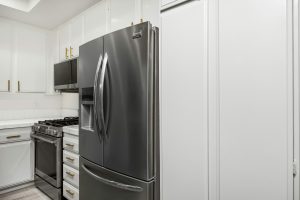
Samsung RF, RS, RT, and RB refrigerators cover everything from basic top-mount units to Family Hub French-door models, and the cost to repair one varies a lot depending on which system inside actually failed. Here’s what drives that variation.
Sealed system versus accessible components
The biggest cost gap in refrigerator repair is between sealed-system work and everything else. A compressor lock (code 84C) or a low-voltage problem (85C) affecting the compressor circuit involves the refrigerant sealed system — this is specialized, often requires refrigerant recovery and recharge, and should only be handled by a technician certified under EPA Section 608. By contrast, a fan failure (21E freezer fan, 23E condenser fan, or 22E fridge fan on combo units) usually means replacing an accessible fan motor, which is far less involved.
Ice-maker and defrost problems
Codes like 5E (defrost sensor), 8E or 14E (ice-maker sensor), 33E (ice pipe heater), 39E (ice-maker function), and 40E (ice-room fan) all relate to the ice-making and defrost systems shared across the fridge, freezer, and standalone ice-maker line. These components are generally accessible without touching the sealed refrigerant system, which keeps repair scope — and cost — more contained than compressor work, though reaching some of them on French-door and Family Hub models can mean removing interior panels.
Control board and communication problems
41E points to the freezer main control board, while 88 88 (displayed after a power loss) and PC ER/PC CH indicate a communication problem between boards. On Family Hub models, the added display and SmartThings connectivity module is another point of failure that a standard RF unit doesn’t have, and that board tends to be more expensive given the added electronics. OF OF isn’t actually a failure — it means Cooling Off or demo mode is active, often left on by accident after delivery or a showroom setting, and costs nothing to fix once identified.
Diagnostic complexity
Because the refrigerator, freezer, and ice-maker share one control-board code family, a single displayed code doesn’t always point to one obvious part — a 5E defrost sensor code, for instance, can stem from the sensor itself, its wiring, or a control board misread. Confirming which one takes hands-on testing, and that diagnostic time is baked into any accurate quote.
Door seals, gaskets, and everyday wear
Not every refrigerator repair starts with an error code. A door gasket that’s cracked or no longer sealing tightly lets warm air into the cabinet, forcing the compressor and fans to run longer than they should — over months, that added strain can contribute to a fan or compressor failure that might otherwise have been avoided. Replacing a worn gasket is a comparatively small repair, and catching it before it leads to a bigger cooling-system issue is generally the more affordable path.
Model-specific complexity
A standard side-by-side or top-mount RS or RT model has fewer moving parts than a French-door RF unit with dual evaporators and independent fresh-food and freezer fan systems, which naturally means more potential points of failure and more components a technician needs to check through during diagnosis on the higher-end configuration.
Getting a reliable estimate
Refrigerator repair costs are best understood after an in-person diagnostic rather than from the code alone, since the same symptom can stem from a simple part or from sealed-system work. Our refrigerator repair technicians are equipped to diagnose both accessible components and sealed-system problems, and you can check what a specific code means on our refrigerator error code page.
This guide is provided by an independent appliance repair service and is not affiliated with Samsung.