Samsung refrigerator fan error codes such as 21E, 22E and 23E tell you the control board saw a cooling fan that was not turning when it should. Frost jamming the blades, something blocking the fan or a worn motor are the usual causes. Unplug the refrigerator for five minutes to clear a one-time glitch, and if the code returns, protect the food and book a technician, because a dead fan lets the cabinet warm up.
A modern frost-free refrigerator does not cool by sitting cold; it moves cold air. Fans pull air across the evaporator and push it into the compartments, and the control board watches them. If a fan stalls, the board raises a code instead of letting you find out from spoiled food. This guide to Samsung refrigerator fan error codes explains how to tell the fans apart, what each code points to, which checks are safe for an owner, and which belong to a technician. The exact meaning of each code sits on its own page on this site, linked below, so confirm the code against your model before you act.
What do the Samsung refrigerator fan error codes mean?
The 21E, 22E and 23E codes belong to one family: the board has noticed a problem with a fan in the cooling system. Each code points to a different location in the cabinet, such as the fan that serves the freezer, the fan that serves the fresh-food section or the fan that serves the ice area. Open the matching page to see which fan your display refers to, because the same number can appear on a freezer model with its own wording.
Why do cooling fans stop on a Samsung refrigerator?
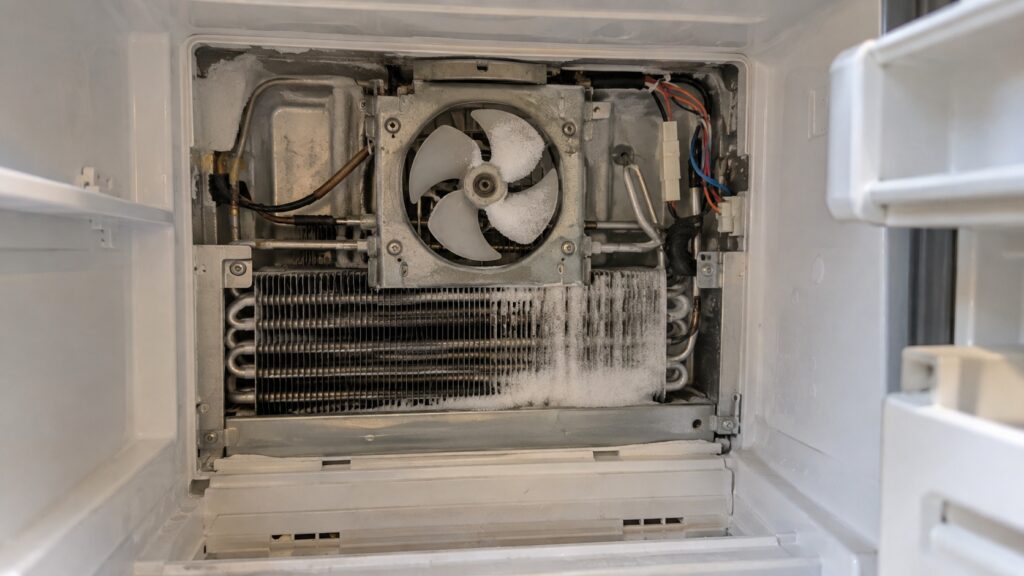
Frost is the most common cause, and it is a clue that the problem is bigger than the fan. If the defrost system does not clear the evaporator, ice builds up behind the freezer panel until it touches the fan blade and stops it. The fan then fails because of the ice, and the ice is there because defrost failed. Replacing only the fan would bring the code back within weeks. Our guide on Samsung freezer defrost drain maintenance shows how a blocked drain feeds this cycle.
The other causes are simpler. A fan motor wears out after years of running and starts to squeal, then drags, then stops. A small object, such as a bit of packaging that slipped behind a shelf, can catch a blade. A loose connector or a damaged wire can cut power to the fan. And on some models the fan is switched off while the door is open, so a door that does not close fully or a worn door switch can confuse the picture.
What will I notice before or alongside the code?
Watch for a change in sound: a buzz, rattle or scraping from the freezer back wall, or the compressor running much longer than usual. Feel the air at the vents inside the cabinet; weak or absent airflow with a running compressor is the classic sign of a stopped fan. Look for frost on the rear wall of the freezer, ice on the floor of the compartment or water pooling near the drain. The fresh-food section usually warms first, because it depends on air from the freezer.
If food is already warming, stop worrying about the code and move perishable food into a cooler with ice. Food is safe at 40 degrees Fahrenheit or colder in the refrigerator and 0 degrees Fahrenheit in the freezer; an appliance thermometer tells you quickly whether the cabinet is holding temperature.
What can I safely check at home?
First, make sure the doors close fully and the shelves and bins are not wedged against the back wall, since stacked food in front of the vents blocks airflow. Second, unplug the refrigerator for about five minutes, then plug it back in; this clears a one-time glitch and costs nothing. Third, listen for the fan with the door closed and the compressor running, and press the door switch with your finger while you listen to confirm the fan responds. Fourth, look for visible frost on the back panel inside the freezer.
Do not chip ice with a tool or point a hair dryer at the panel for long. The liner, the wiring and the sensors are easy to damage. Do not remove the rear panel to inspect the fan unless you are sure the refrigerator is unplugged, and even then the fan, heater and sensors behind it are best left to a technician. If heavy frost is present, a controlled defrost can be a temporary fix: unplug the unit, empty the freezer into coolers, leave the doors open with towels on the floor and wipe it dry.
When should I call a technician?
Call when the code returns after a restart, when frost builds again within days of a defrost, when the fan is noisy or silent with a running compressor or when food is warming. A technician can test the fan motor, check the defrost heater and sensor, clear the drain and find out whether the fan is the cause or the victim. Note the model number, the exact code and when it first appeared, and bring up the whole chain, not just the fan. The family overview in our Samsung refrigerator error code diagnostics and the refrigerator troubleshooting guide help you describe the symptoms. When you are ready, see Samsung refrigerator repair or schedule a visit.