The samsung dryer he code is an overheat warning, not a failure to heat — and that reversal is why it gets ignored. On this site the code page states it directly: the heating circuit is not responding correctly, and HE, also shown as HC, means the control board has seen drying air above safe limits and shut the heating element or gas valve down to prevent damage or a fire risk. Clearing the code and starting another load is the one response that makes the situation worse.
What does HE mean on a Samsung dryer?
A dryer is a controlled fire hazard held in check by moving air. The element or the burner raises the temperature of incoming air, the blower pulls that air through the drum and out through the duct, and a thermistor reports the temperature back to the control board so it can cycle the heat. As long as air keeps moving, the system stays inside its window.
HE appears when that window is breached. The board reads a temperature it should never see, decides the fault is not something it can correct by cycling the heat, and removes the heat source entirely. The drum may keep turning and the blower may keep running, which is exactly right — the machine is cooling itself down.
Because the symptom people notice is laundry that comes out damp, the code gets read backwards as a heating failure. It is the opposite. The dryer heated too well, or the heat had nowhere to go.
Why is restricted airflow almost always the cause?
Heat that cannot leave a dryer accumulates. Every restriction between the drum and the outside wall raises the temperature of the air sitting around the element, and the temperature rise is not gradual once the duct is more than half blocked.
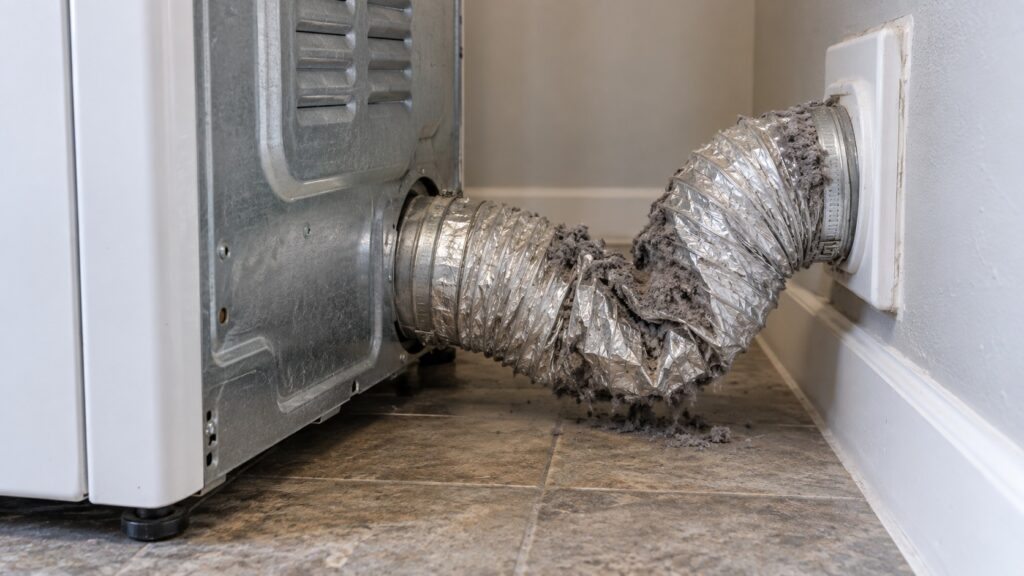
The restrictions arrive in a predictable order. Lint passes the screen in small quantities on every load and settles wherever the air slows down — at the blower housing, at the first elbow, at the flapper on the outside wall. A transition hose behind the machine gets crushed when the dryer is pushed back against the wall. A vent run that was already too long gets longer when a kitchen is remodeled.
This is also why HE tends to appear in clusters rather than once. The duct did not block overnight, and clearing the code does nothing to the lint. Our guide on Samsung dryer maintenance covers the cleaning intervals that keep the duct ahead of the problem.
What can I check safely myself?
Unplug an electric dryer or shut the gas valve on a gas model before you move anything, and give the machine an hour to cool if it just stopped.
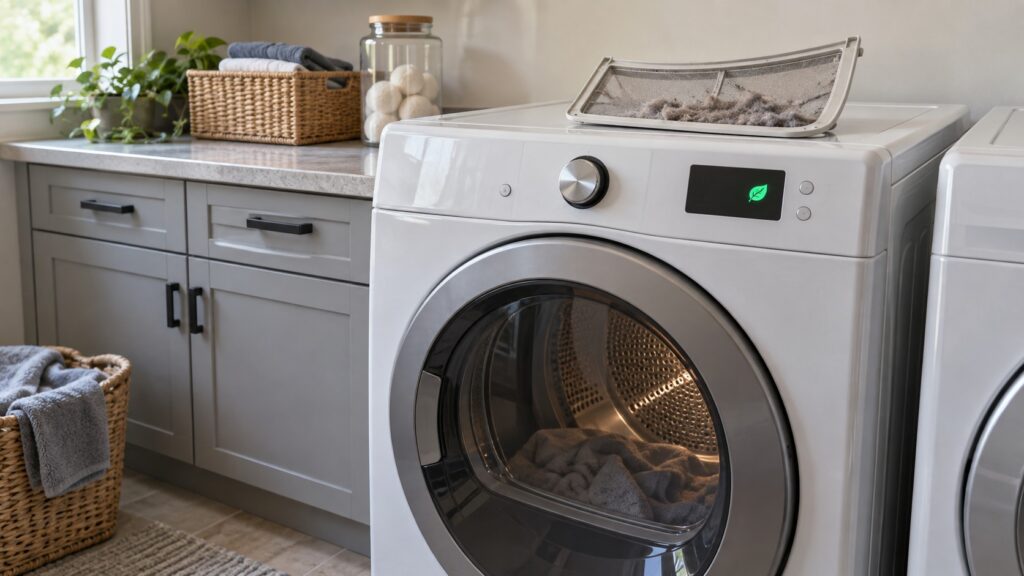
- Pull and clean the lint screen, then hold it under running water. Water that beads or pools rather than passing straight through means fabric softener film is sealing the mesh. Scrub it with a brush and dish soap.
- Look into the lint screen housing with a flashlight. A narrow vacuum attachment reaches most of what has collected below the slot.
- Pull the dryer forward and look at the transition hose. Foil accordion hose crushed to a third of its diameter is common and is a genuine fire risk in its own right.
- Disconnect the hose and run the dryer for a minute on air fluff. Strong airflow at the back outlet with the hose off, and weak airflow at the outside wall with it on, isolates the fault to the duct.
- Check the outside flapper. Lint mats, bird nests and a flap frozen shut in winter all show up at the wall cap.
If airflow is strong all the way to the exterior cap and HE still appears within a load or two, the fault has moved inside the machine.
What fails inside the dryer when the duct is clear?
Three components sit between the heat source and the board, and any of them can produce a genuine overheat.
- The thermistor. It reports air temperature. A thermistor drifting out of tolerance makes the board believe the air is far hotter than it is, or lets real heat climb unreported until a backup device trips.
- The heating element. A coil that has sagged and touched its housing conducts to ground and heats continuously, regardless of what the board commands.
- The relay on the control board. Welded contacts leave the element powered through what should be an off period.
There is also a thermal fuse and a high limit thermostat in the circuit as last resort protection. A tripped thermal fuse gives a dryer that tumbles with no heat at all and no code, which is a different complaint than HE — replacing that fuse without finding what overheated guarantees a repeat. The broader Samsung dryer error code diagnostics guide sets HE alongside the rest of the set, and the HE code page lists the affected components.
Is HE the same as HC, and how does it differ from 3C?
HE and HC are the same fault shown with different characters on different panel generations. Reading one as a heating problem and the other as something else sends people to the wrong parts list.
3C is not related. It points at the drive motor circuit rather than the heat circuit, and it stops the drum instead of removing heat. A dryer that tumbles but will not heat, with no code showing, is usually a tripped thermal fuse or a broken element and belongs in the Samsung dryer troubleshooting guide rather than here.
One more distinction matters for diagnosis. Clothes that come out damp with no code at all often point at the moisture sensor bars inside the drum rather than at heat, and cleaning those bars is a five minute job — our guide on Samsung dryer moisture sensor cleaning walks through it.
What does it cost to leave HE alone?
Dryer fires are overwhelmingly airflow fires, and HE is the machine telling you it has met the conditions for one. Beyond safety, sustained overheating cooks the drum bearings and the belt, scorches fabric, and shortens the element that was already working hard.
There is a household cost too. A dryer fighting a blocked duct runs two or three cycles where one would do, and every one of those cycles is paid for. Clearing a vent run is the cheapest thing anyone does to a dryer all year.
When should a technician take over?
Call when HE returns after the full duct has been cleared end to end, when the dryer overheats with the vent hose disconnected entirely, when the drum or the cabinet becomes hot to the touch, or when there is any smell of scorching. Gas models with HE should not be run again until someone has looked at the burner and its sensing.
We are an independent repair company and not a factory service arm. Pricing starts from a diagnostic visit and we confirm the estimate before any work begins. Thermistors and thermostats are inexpensive parts and the visit is usually a single trip. Samsung dryer repair covers elements, thermistors, thermostats, blowers and boards, and you can schedule a visit online.