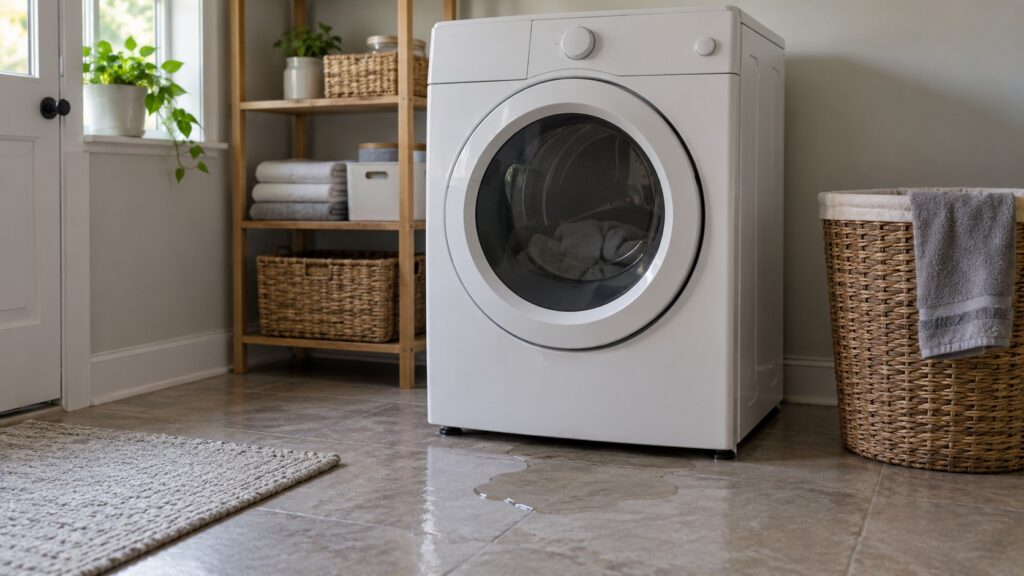
When a Samsung dryer is leaking water, the water usually is not coming from the drying system at all: a vented dryer heats air and does not normally use water, so a puddle most often traces to a steam model’s water connection, to condensation running back from a long or kinked exhaust duct, to wet laundry dripping from the door, or to a neighboring appliance such as the washer. Find where the water first appears before you touch anything, and treat water together with electricity seriously: if water is near the plug, the cord or the back of the dryer, switch the breaker off from a dry floor before you do anything else.
Why would a Samsung dryer leak water?
A dryer removes moisture from clothes as vapor and carries it out through the exhaust vent, so in normal operation there is no water to leak. Water on the floor therefore means that one of four things happened: water came in through a supply connection that only some steam models have, vapor condensed in the duct and ran back, wet laundry dripped, or the water came from somewhere else and the dryer is only sitting in it. Our Samsung dryer overview lists the DVE electric and DVG gas dryers as sharing most of the same drum, motor and sensor architecture, and notes that higher-end models add Steam Sanitize+ cycles, so the first question is whether yours has steam.
Is the water really coming from the dryer?
Check this first, because laundry rooms hide leaks. Switch the dryer off at the breaker first if the floor is wet near the plug or cord, mop the floor dry and look around: is the washer next to it, is there a laundry sink, a water heater or a floor drain nearby, and is the wall behind the dryer wet? Once the floor is dry and the area is safe, note where the first drops reappear and when: if the water only appears after the washer runs, the washer or its hoses are the source, not the dryer. If the water is only in front, look at the door and the load. If it is at the back, look at the connections. A leak that follows a washer cycle is not a dryer problem, and our Samsung washer pages cover that side.
Could the water supply on a steam model be leaking?
If your dryer has a steam function, check whether your model connects to a water supply and, if it does, look at that connection. Our Samsung dryer overview mentions steam cycles on higher-end models, but whether a given model is connected to the water line differs by model, so read the installation and care sections of your owner’s manual. If there is a supply hose, look for a damp fitting at the dryer end and at the shutoff valve, and check that the hose is not kinked or crushed behind the dryer. Close the shutoff valve to stop the leak. Do not over-tighten a plastic fitting, and do not pull the dryer out so far that the hose or the vent comes loose. A fitting that still drips after the valve is closed and the hose is reseated needs a technician or a plumber.
Can the exhaust duct cause water to drip?
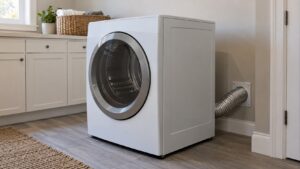
Yes. Warm, moist air leaving the dryer cools in the duct, and if the duct is long, sags, has many bends or runs through a cold space, some of that moisture condenses into water. The water can run back along the duct and drip at a joint or at the dryer’s rear connection, or run down the wall. Condensation in the duct is a general explanation rather than something our pages describe. Our installation checks page says Samsung specifies a maximum vent length and a maximum number of 90-degree bends for its DVE and DVG dryers, that rigid or semi-rigid metal duct performs far better than accordion-style foil or plastic hose, and that a duct kinked behind the dryer restricts airflow in the same way as one that is too long. With the dryer unplugged, look at the duct for sags and kinks and clean it out. On a DVG gas dryer, do not pull the dryer out or move it yourself, because the flexible gas connector must not be kinked, and leave the gas connection to a technician. A restricted duct also makes drying slow and hot, which is a fire risk: see our Samsung dryer installation checks.
Can the door leak?
Water at the door is usually the load. Clothes that come out of a washer that spun poorly, a soaked towel or a heavy item can drip when the door opens or when it tumbles, and a steam cycle can leave moisture on the glass and the seal. Run the load through a longer spin cycle in the washer, check that the washer drains properly and do not overfill the dryer. Wipe the door seal and the lint filter area, and make sure the lint screen is clean, since a clogged screen keeps moisture in the drum. Our dryer moisture sensor cleaning guide explains why the moisture strips need to be kept clean so the dryer ends a cycle at the right point. Persistent water on the door seal or inside the drum after a normal load is worth a diagnosis.
What should you do if there is a lot of water?
If water is pooling around the dryer, near the plug or running under the back, switch the circuit breaker off from a dry position and keep your hands away from the cord and the outlet. Do not run the dryer to see whether it leaks again. If it is a DVG gas dryer and you smell gas, do not touch switches or light anything: leave the home and call your gas utility or 911 from outside. Close the water valve if a hose is the source, mop up and dry the floor and the wall behind the dryer, and look under the dryer for water that may have reached the electrical parts. Do not open the back or the cabinet to look. A dryer that has taken in water should be checked by a technician before it is used again.
When should you call a technician?
Call if you cannot find the source after you have checked the connections, the duct, the load and the neighboring appliances, if the leak returns after you have corrected the duct, if a code appears or if water has reached the electrical parts. Our guide to Samsung dryer error code diagnostics explains what the common codes mean, and our Samsung dryer repair page explains how a visit works.