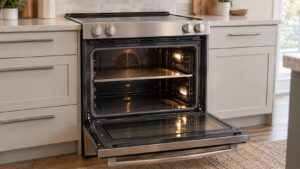
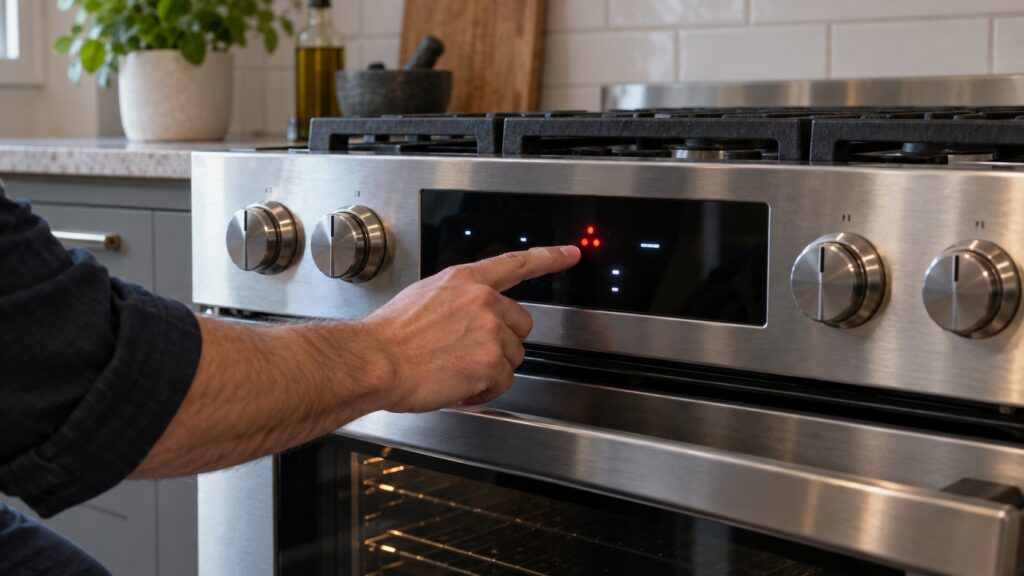
Samsung reuses the same C-code across its range, wall oven and cooktop control boards, and the code on its own does not tell you which part triggered it. A Samsung C-20 on a range display and a Samsung C-20 on a cooktop display point at different circuits, because each appliance’s control board assigns the same numbered code to whatever fault its own diagnostic table lists in that slot. Look up the bare code without confirming which appliance it came from, and you can spend an hour checking a part that was never involved.
What does Samsung error code C-20 mean on a range?
On a Samsung range, C-20 means the oven sensor circuit is open, shorted, or reading outside its normal range — the control board cannot trust the temperature the sensor is reporting, so it stops the heating cycle rather than cook blind. This is the single most common reason a Samsung range shows a fault code during a bake or roast, and it is a sensor-circuit problem, not a heating-element failure by itself.
The same C-20 on a Samsung wall oven reads almost identically — oven temperature sensor circuit failure — because a wall oven and a range oven cavity share very similar sensor wiring. On a Samsung cooktop, however, C-20 is described more broadly as a temperature sensor or surface control condition, which is a different physical sensor entirely: a cooktop has no oven cavity, so its C-20 concerns the surface or induction control sensing, not an oven probe.
Why do C-22 and C-24 mean genuinely different things by appliance?
C-22 is the clearest example of two different faults sharing a number. On a range, C-22 is a temperature sensor failure on compatible cooking controls — a sensor problem, similar in nature to C-20. On a cooktop, the same C-22 means the cooktop overheated or its cooling airflow is restricted, which is a thermal-protection trip, not a sensor fault. Chasing a sensor on a cooktop showing C-22 wastes time; the fix there starts with checking ventilation and clearance around the unit, not the sensor wiring.
C-24 goes a step further and diverges across all three appliances. A range reads C-24 as a low-voltage or induction module condition. An oven reads the identical code as a heating condition that did not meet the expected control response — a broader catch-all for the bake cycle behaving outside spec. A cooktop reads C-24 as a demo mode or control state requiring diagnosis, which can mean the unit is simply stuck in a showroom display mode rather than reporting a hardware fault at all. Three appliances, three unrelated conditions, one shared number.
What do C-F0, C-F1 and C-F2 have in common — and where do they split?
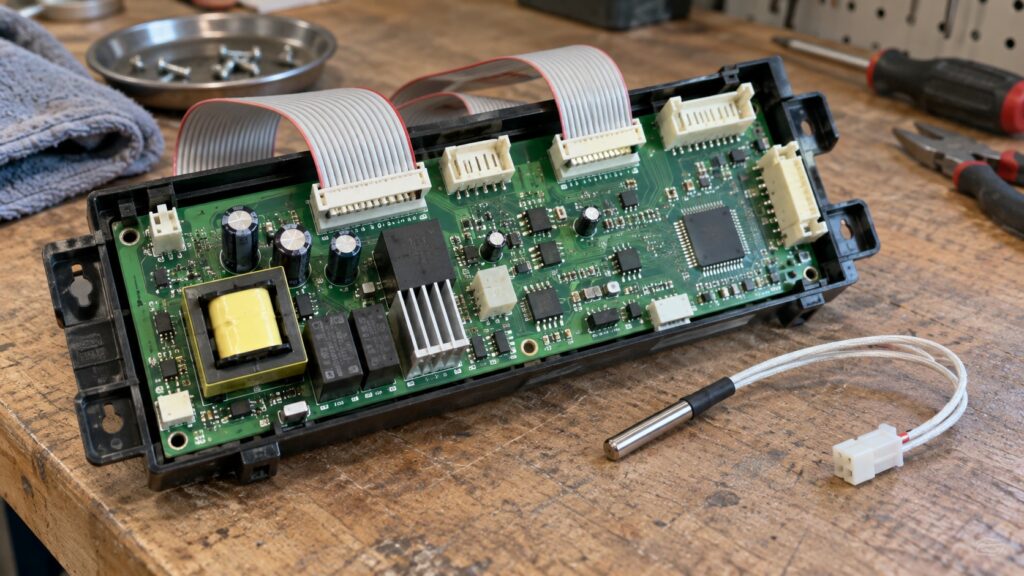
The C-F family is mostly about communication rather than sensing. C-F0 and C-F2, on both a range and an oven, describe the same kind of fault: the display board and the main control board (or two boards generally, for C-F2) have stopped communicating cleanly. That consistency makes the C-F family easier to trust across those two appliances than the C-2x family above.
Cooktops break that pattern. C-F1 shows up only on a cooktop in this range of codes, described as a control or zone input error — there is no range or oven C-F1 to compare it to, so do not assume it maps to a communication fault the way C-F0 does. C-F2 on a cooktop also shifts meaning slightly from the range and oven version: it becomes an induction module communication or sensor issue, tying the fault to the induction hardware specifically rather than a generic board-to-board link.
How are C-d0 and C-d1 different from each other, even on the same range?
These two are easy to mix up because they look like a matched pair, but they are not equally distributed across appliances. C-d0 exists on both a range and an oven, and in both cases it concerns a divider or door switch that is not confirming its position — on a range with a divided-cavity design, that switch tells the control board whether the divider is seated. C-d1 exists only on a range in this code set, and it means something more specific: the door lock circuit itself is not reporting position correctly, which is a self-clean-cycle safety concern rather than a divider issue. A cooktop has no door and no divider switch, so what looks like the same family on a cooktop display — plain “d0” without the C- prefix — is actually a separate low-voltage or induction module code, unrelated to a door or divider at all.
What should you check before calling for repair?
Whatever the code, start by confirming which appliance it came from and reading the exact code as displayed, including whether it has the C- prefix or appears as a bare pair of characters like the cooktop’s “d0.” Power-cycle the unit at the breaker for a minute; a code that clears on restart was reporting a condition the board could recover from, and a code that returns immediately is reporting something live. Avoid opening the back panel or the control housing yourself — the sensor circuits and induction modules behind a C-code sit close to line voltage, and on a sealed control board they are not designed for casual access. Regular upkeep from our Samsung range maintenance guide also reduces how often sensor-circuit codes like C-20 and C-22 show up in the first place.
Our technicians diagnose Samsung C-codes by appliance first, so a range, an oven and a cooktop each get read against the correct fault table rather than a generic list. We are an independent repair service, not a factory service arm, and pricing starts with a diagnostic visit that we confirm with you before any work begins. If your range, oven or cooktop is showing one of these codes, schedule Samsung range repair or see our range hood venting guide if a nearby ventilation issue is part of what triggered a thermal code. You can also schedule a visit directly with the exact code and appliance noted.