Before assuming a Samsung range needs a repair, it is worth ruling out installation issues — a range that was never leveled, wired, or vented correctly can mimic symptoms that look like component failure. This guide covers what to check first, written independently and not affiliated with Samsung.
Power and connection checks
Electric NE ranges require a dedicated 240-volt circuit, and a loose or undersized connection at the terminal block behind the range can cause intermittent display resets, flickering elements, or a range that trips its breaker under load. Gas NX and dual-fuel ranges still need a properly grounded electrical connection for the control board, igniters, and clock — a poor ground is a common hidden cause of erratic C-F0 or C-F2 communication problems that look like a board problem but are actually a wiring issue upstream.
Leveling and clearance
- Leveling legs: an unlevel range can cause uneven cooking, oil pooling to one side of a pan, and in some cases affects how the self-clean door latch engages. Use a bubble level front-to-back and side-to-side, adjusting the front leveling legs as needed.
- Rear clearance: gas ranges need adequate space behind the unit for the flexible gas connector to sit without kinking, and electric ranges need clearance so the power cord isn’t pinched against the wall.
- Anti-tip bracket: Samsung ranges ship with an anti-tip bracket that must be installed and engaged. This is a safety requirement, not optional hardware, and its absence is one of the most commonly missed installation steps.
Gas-specific checks (NX and dual-fuel models)
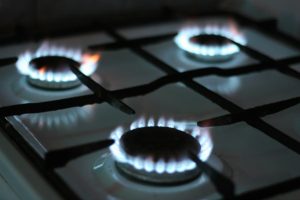
A gas range that struggles to light, clicks repeatedly, or has a weak flame is sometimes an installation problem rather than a failed igniter — low incoming gas pressure, a partially closed shutoff valve, or air trapped in the line after installation can all produce symptoms that look like igniter failure. If every burner and the oven igniter are all weak at once, suspect the gas supply before replacing parts. A single weak burner, on the other hand, more often points to that burner’s individual igniter or valve.
Ventilation and airflow
Poor clearance around the range or a blocked oven vent can trigger a C-24 code, which Samsung ties to the oven heating faster than expected or a blocked vent path. Before assuming the temperature sensor has failed, confirm nothing is stored on top of the range blocking the vent opening near the control panel, and that cabinetry above the range meets the manufacturer’s minimum clearance.
Countertop material and surrounding cabinetry
Slide-in range installations depend on a properly sized gap and matching height between the range and the surrounding countertop. A gap that’s too wide lets spills fall into the cavity behind the range, where they can reach wiring and the control board over time. Cabinetry installed too close on either side can also restrict the small side vents some models use for cooling the control electronics, contributing to nuisance resets during long baking or self-clean cycles.
When installation checks don’t resolve the issue
If you’ve confirmed level installation, secure power or gas connection, proper clearance, and the anti-tip bracket is engaged, and you’re still seeing error codes or inconsistent cooking performance, the issue is likely a genuine component problem rather than setup. At that point a technician can run proper diagnostics on the igniter, control board, or temperature sensor. Visit our range repair service page to schedule a visit, or reference Samsung’s installation manuals at samsung.com/us/support for model-specific clearance requirements.
This guide is provided by an independent appliance repair service and is not affiliated with, endorsed by, or sponsored by Samsung Electronics.