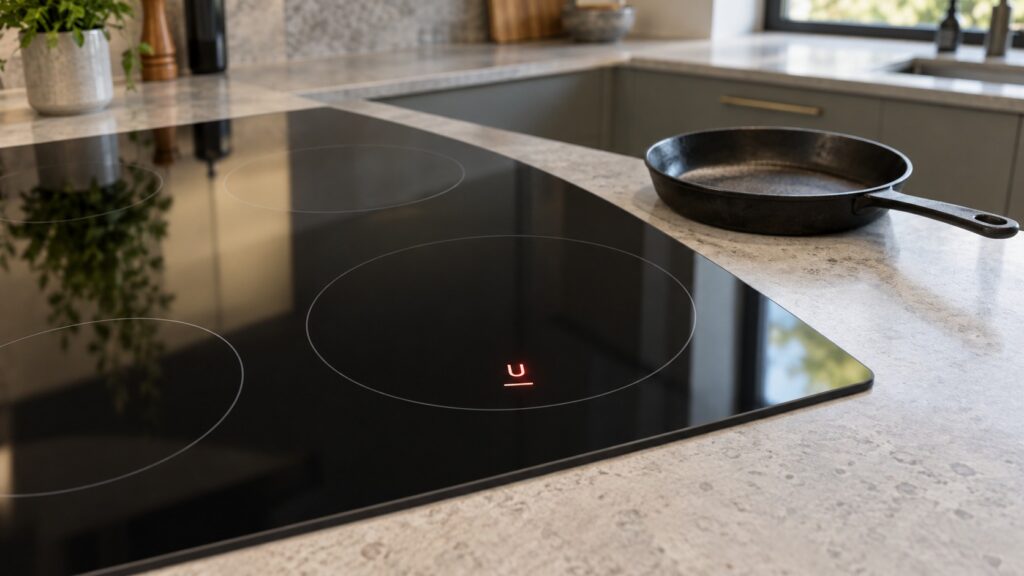
An underlined u glowing on an induction zone is not a breakdown. Samsung cooktop pan detection is telling you the zone cannot sense compatible cookware on the glass, and the site’s own code page puts it plainly: this is the pan detection indicator, not a general error code. Induction only heats when the coil under the glass sees a magnetic load, so with the wrong pot the burner does nothing at all — exactly as designed.
What does the underlined u mean on a Samsung cooktop?
Induction works by inducing a current in the cookware itself. The coil beneath the glass creates a changing magnetic field, the base of a ferrous pan resists that field, and the resistance produces heat in the metal. The glass stays comparatively cool because it is not the thing being heated.
For that to happen at all, the cooktop first has to confirm a magnetic load is sitting on the zone. It sends a low power pulse and measures what comes back. If nothing meaningful returns, powering the coil would waste energy and stress the electronics, so the zone refuses and shows the indicator instead.
This is also why induction feels instant when it works and completely dead when it does not. There is no gradual warming to tell you something is half right. Either the field couples with the pan or it does not.
Which pans work, and how do I test mine?
Carry a refrigerator magnet to the cupboard and spend five minutes on it. Press the magnet against the outside of each base. A magnet that grips firmly means the pan will work. A magnet that falls off, or clings weakly enough to slide, means it will not.
- Cast iron and enameled cast iron. Always work, and couple strongly.
- Carbon steel. Works well, and heats fast.
- Magnetic stainless steel. Works when the base is magnetic — not all stainless is.
- Clad pans with a steel disc. Usually work, as long as the disc covers most of the base.
- Aluminum, copper, glass and ceramic. Do not work at all on their own.
Cookware sold as induction ready normally carries a coil symbol stamped on the base. The magnet is still the better test, because the symbol has been applied optimistically to pans with a very thin magnetic layer that the zone struggles to see.
Why does a pan that used to work stop being detected?
Three things change over time, and none of them is the cooktop.
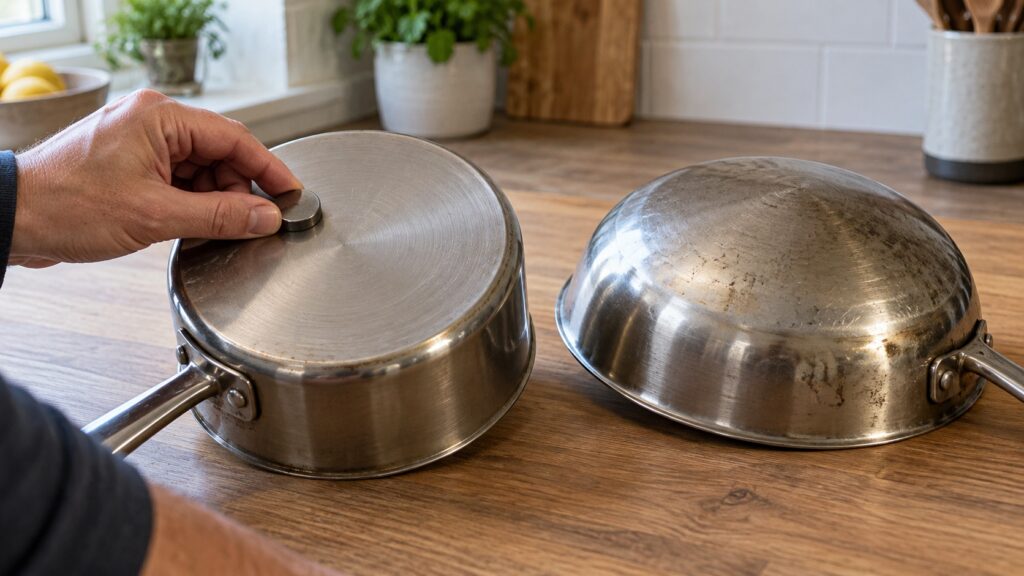
The first is the shape of the base. Repeated heating and cooling, and the occasional cold rinse of a hot pan, leave bases domed or warped. A base that rocks when you press its edge on a flat surface touches the glass only in a narrow ring, and the coupling drops away with it.
The second is what sits between the pan and the glass. A film of burnt sugar, a cooktop protector mat, a trivet, or a sheet of paper towel used to stop scratches all increase the gap. Induction tolerates a very small gap and nothing more.
The third is where the pan sits. A base nudged off center covers less of the coil, and small pans moved a couple of inches off the ring drop below the detection threshold that they were only just meeting before.
Does pan size matter on an induction zone?
Very much, and it is the cause people find least intuitive. Each zone has a minimum base diameter it will recognize, printed in the model’s own documentation, and a base smaller than that is invisible to the coil no matter how magnetic it is.
A small saucepan that works on the smallest zone and shows the indicator on the largest zone is behaving normally. Match the pan to the ring: the base should cover most of the printed circle rather than floating in the middle of it. Undersized pans on large zones also cycle the power on and off as the detection wavers, which reads as a cooktop with a mind of its own.
Flat bottomed woks, milk pans and small espresso pots are the usual offenders. Several Samsung cooktops offer a flex zone that bridges two elements for a griddle or a long pan, and using it for a small pot is the same mistake in a different shape. Our Samsung cooktop care tips cover cookware habits that keep the glass and the coils in good order.
When is it a genuine fault rather than the cookware?
The line is easy to draw. Take a pan you know works — cast iron is the reliable test — and put it squarely on each zone in turn. If every zone heats it, nothing is wrong with the cooktop and the answer is in the cupboard. If one zone refuses a pan the others accept, that zone’s coil or its control is suspect.
Look also at what else the panel says. A zone input or control error shows as C-F1, and a temperature sensor or surface control condition shows as C-20 — both of those are real codes rather than indicators, and both belong to the cooktop rather than the pan. The pan detection page explains the underlined u in detail, while our Samsung cooktop error code diagnostics guide covers the coded faults.
One more pattern worth knowing: zones that cut out under load after several minutes, with or without an indicator, often point at cooling rather than detection. That is a fan and airflow question, and the Samsung cooktop troubleshooting guide works through it.
What habits keep the indicator away?
Buy fewer pans and buy them properly. A magnetic base, thick enough not to warp, sized to the zones you actually use, is the whole requirement. Wipe the glass and the pan base before cooking, because a crust of sugar on either one is a spacer.
Set pans down rather than sliding them, which keeps both the glass and the base flat. Let a hot pan cool before it meets water. Skip cooktop protector mats on induction entirely. And keep the vents around the cooktop clear so the electronics below stay cool, which is a different failure but arrives the same way — quietly, after months of small compromises.
We are an independent repair company and not a factory service arm. Pricing starts from a diagnostic visit and we confirm the estimate before any work begins. Samsung cooktop repair covers coils, sensors, touch controls and cooling, and you can schedule a visit online.