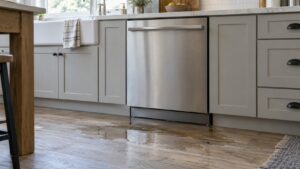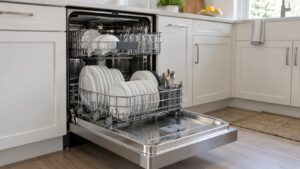
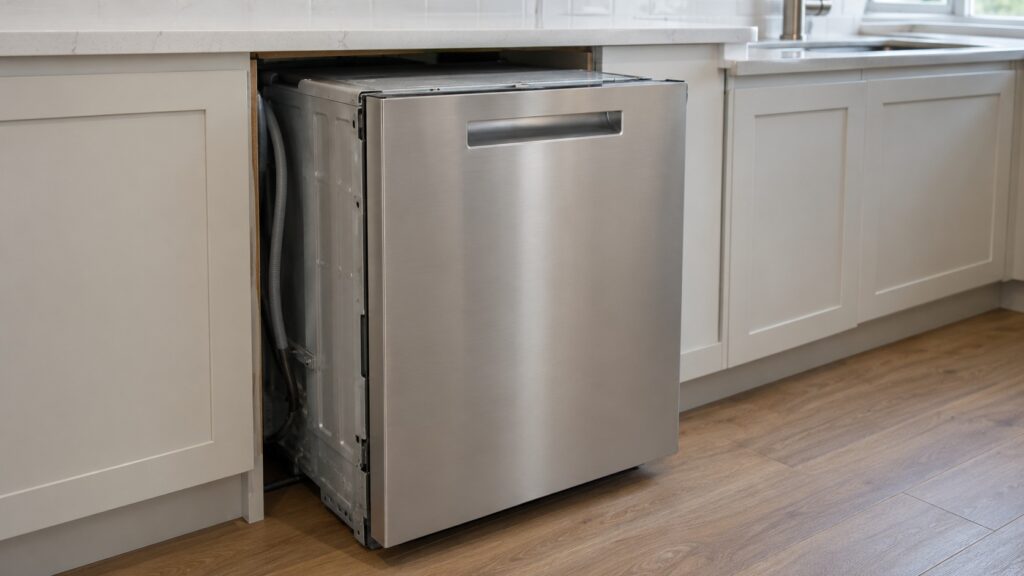
A Samsung dishwasher installation comes down to five things: a level, secured dishwasher in the right opening, a drain hose routed with a high loop, a disposal knockout plug that has been removed if you have a disposal, an open and unkinked water supply, and a power connection that matches the data plate. The Samsung dishwasher drain loop is the one people ask about most, because a hose that runs flat or sags can siphon dirty water back into the tub or stop the dishwasher from draining at all. The exact loop position, hose lengths, fittings and clearances are in the installation manual for your model, and that manual wins over any general guide.
What does a Samsung dishwasher need before it goes in?
Start with the opening and the connections. Samsung’s DW80 line is a full size 24 inch built-in dishwasher, so the cabinet opening must suit that size, with the clearances given in the installation manual at the sides and back. The models on this site include DW80CG4021SR, DW80K7050US, DW80R7060US, DW80B6060US, DW80B7070US, DW80CG5451SR, DW80CB545012, DW80BB707012 and DW80R9950US. They differ in features, but the basics of drain, water and power are the same. Before the dishwasher arrives, confirm that the water shutoff valve, the drain connection and the electrical supply are within reach, that the floor is solid and level and that the route from the door to the kitchen is clear. If the old dishwasher is being removed, switch off the water at the valve and the dishwasher’s breaker first, and mop up any water before the new one goes in.
How should the drain hose be routed?
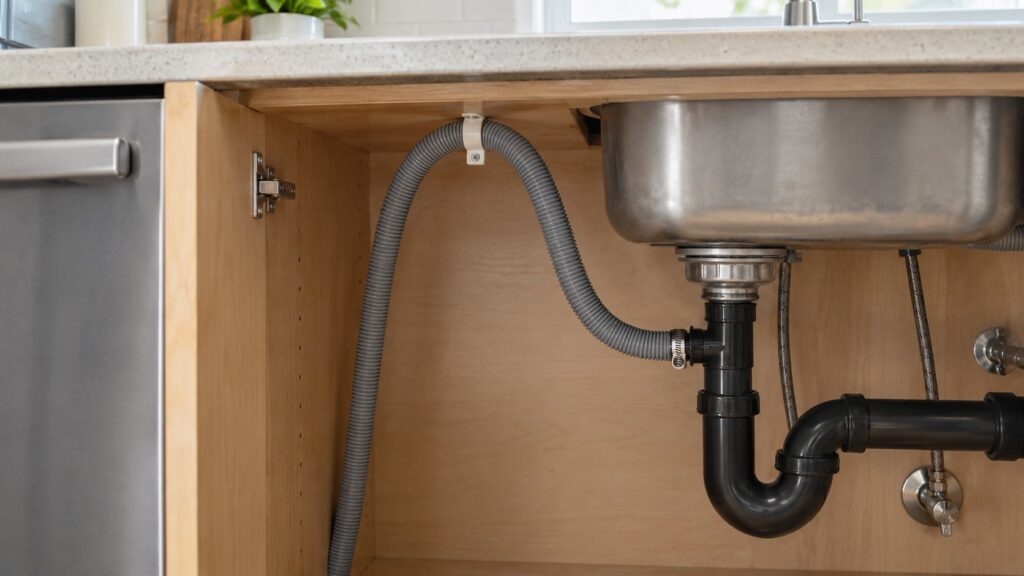
With a high loop. Our installation checks page says the drain hose should have a proper high loop, typically secured under the counter near the top, to prevent siphoning that can pull water back into the tub or trigger a drain problem (the 5C or 5E code). In plain terms, the hose rises toward the underside of the countertop before it drops to the sink drain or the disposal, so that dirty water cannot run backward into the dishwasher. A hose that runs flat along the cabinet floor, sags in the middle or is crushed behind the unit does the opposite. Many installations also include an air gap fitting on the countertop, or equivalent high-loop routing, to prevent backflow. The height of the loop and the type of fastening are specified by the installation manual for your model, so use those and not a number from the internet. If the sink drains slowly and you see water backing up into the dishwasher between cycles, the air gap or high loop may be clogged or missing, not the dishwasher’s pump.
What about the garbage disposal knockout plug?
If the dishwasher drains through a garbage disposal, the disposal’s dishwasher inlet has a knockout plug that must be removed when a new disposal is installed. A forgotten plug blocks drainage completely and is one of the most common installation oversights, according to our installation checks page. It shows up as a new dishwasher that fills and washes but leaves the tub full of water, and as the 5C or 5E code. Remove the plug with the disposal unplugged or its breaker off, and take the plug out of the disposal chamber so it does not jam the grinder. If you are not sure whether the plug is gone, ask the installer to confirm it, and do not reach into the disposal chamber unless it is unplugged or its breaker is off.
How should the water supply be set up?
The shutoff valve under the sink must be fully open, and the flexible supply line must run to the dishwasher without a kink or a pinch. A restricted supply is a common cause of the 4C or 4E fill code and of the 9C or 9E low-water code, and it is common after an install or a move to find that the line was crushed behind the unit. Do not over-tighten fittings. If a connection drips after the water is turned on, close the valve, and either re-seat the fitting as the installation manual shows or ask a plumber. Our page on Samsung dishwasher 4C explains the supply checks if the dishwasher will not fill, and the inlet valve has a small mesh filter that can collect sediment.
How do you level and secure it?
Set a level across the top edge of the tub, front to back and side to side, and adjust the leveling legs until it reads level. A dishwasher that is not level can leak at the door gasket, drain incompletely and run louder than it should. Then secure the dishwasher by screwing it to the underside of the countertop with the mounting brackets, because an unsecured unit can shift during a cycle and stress the water and drain connections until one of them leaks. Do not over-tighten the brackets: that can pull the tub out of square and affect how evenly the water is distributed. The side panels must not flex against the cabinets, which is why the clearance from the manual matters. Finally, the door must close and latch smoothly without extra force.
What should you check at the first run?
Before the first cycle, confirm the dishwasher is connected to a properly rated circuit as shown on its data plate. A shared or undersized circuit can cause intermittent power failures that look like a control fault. Make sure the electrical and plumbing connections were made by a qualified installer if you are not one. Start a short cycle and watch: the tub should fill, wash and drain, there should be no water at the door, the hose connections or the base, and the door should stay latched. If it leaks, stops with water in the tub or shows a code, our installation checks before repair guide gives the order to work in. If the model number on your data plate is unfamiliar, our model number guide explains how to read it, and you can compare your model on its own page, such as DW80CG4021SR.
When should you call a technician?
Call if the dishwasher will not fill or drain after you have checked the loop, the plug, the supply and the filter, if water leaks from the base or if a code returns. Switch the dishwasher off at the breaker and close the water valve if you see water near the electrical parts. Our Samsung dishwasher repair page explains what a visit covers.