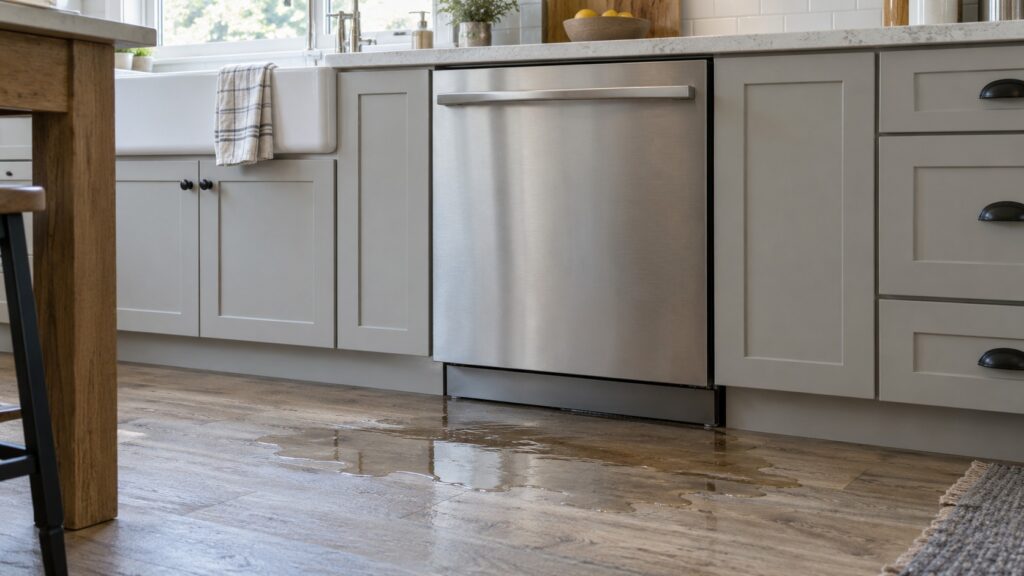
A Samsung dishwasher leaking from bottom or door is usually one of four things: a worn or dirty door gasket, a dishwasher that is not level or not secured to the countertop, a loose or damaged water or drain connection, or too much water in the tub from a stuck-open valve or a failed level sensor. Many Samsung dishwashers also have a leak sensor in the base pan that stops the cycle and shows LC or LE when it detects water. Stop the machine, dry the floor and look at where the water first appears, because the location narrows the cause.
Where is the water coming from?
Dry the floor and the area under and around the dishwasher, then watch where water reappears. Photograph the spot. Our site does not map every position to a single part, so treat the location as a clue rather than a verdict. Water at the front edge of the door points to the door seal or an unlevel machine. Water that appears underneath, or toward a corner, points to the connections, the mounting or water that has collected in the base pan. A puddle that appears only after a cycle behaves differently from one that appears during the fill.
If the machine shows LC or LE, the leak sensor has already told you there is water in the base pan. Our Samsung dishwasher LC code page lists it as a high-severity code with mixed repairability, and the DW80K7050US and DW80R7060US model pages both show it.
Could the door gasket be leaking?
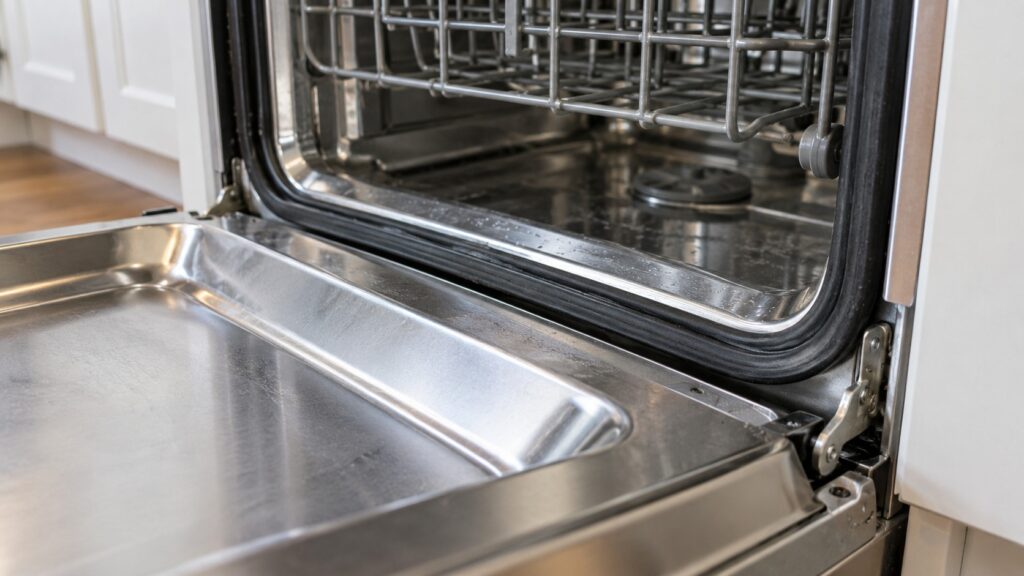
Yes. The rubber gasket around the door is meant to seal water in, and our Samsung dishwasher maintenance guide lists wiping the door gasket and the seal around the tub opening, where grime and mold can build up, in its monthly care. A worn or stiff gasket is a plausible source of a door-edge leak, but this site does not rank it against other causes. Wipe it with a damp cloth to remove food debris and mildew, and look it over now and then for cracking or stiffness. A gasket with debris caught in it will not seal evenly, so clean the whole run, including the corners and the bottom edge.
Also check that the door latches cleanly. If it does not close squarely, water can escape at the door edge even with a gasket in good shape.
Is the dishwasher level and secured?
Our installation checks guide says a dishwasher that is not level can leak at the door gasket, drain incompletely and run louder than it should. Place a level across the top edge of the tub, front to back and side to side, and adjust the leveling legs. The same guide says the unit should be securely screwed into the underside of the countertop, because an unsecured dishwasher can shift slightly during operation, which stresses the water and drain connections over time and can eventually cause a leak. If you slide the dishwasher out to reach the legs, be careful with the hoses and the cord, and ask for help; connection work belongs to a plumber or a technician. Our Samsung dishwasher installation checks guide has the full list.
Could a hose or connection be the problem?
The water supply line must be fully open and free of kinks, and the drain hose should have a proper high loop, typically secured under the counter near the top, to prevent siphoning that can pull water back into the tub. On a sink with a garbage disposal, a knockout plug that was never removed from the disposal’s dishwasher inlet blocks drainage completely and is one of the most common installation oversights. Slow or blocked drainage can show as 5C or 5E, and standing water in the tub can end up where it should not. Our Samsung dishwasher troubleshooting guide and error code diagnostics go through the drain and fill codes.
A cracked hose or a leaking fitting is not an owner repair. If you see water running from a connection, close the supply valve and call.
What if the tub is overfilling?
OC means an over-level water condition or fill control problem and OE means the water level sensor reports an overfill condition. Our error code diagnostics guide says too much water in the tub can stem from a stuck-open water valve or a failed water-level sensor, and both are repairs for a technician. If water keeps entering after the cycle ends, close the supply valve and switch off the dishwasher’s breaker, standing on a dry floor. Do not keep running cycles to see whether it recurs. A clogged filter can also cause drain trouble, so rinse the filter as part of regular care, but a recurring leak after a clean filter, a good gasket and a level machine needs a diagnosis.
What should you do about an LC or LE code?
Do not ignore it and do not reset it again and again. Our troubleshooting guide says a recurring LC or LE code should never be ignored or reset repeatedly; it means the unit has detected water where it should not be, and continuing to run it risks water damage to cabinetry and flooring. Check under the unit for standing water, dry the base area and have the machine inspected promptly if the code returns. A code that clears after unplugging for a minute and does not return can be a minor glitch, but a leak code that repeats is worth diagnosing. Do not pull the plug if the outlet or cord is wet; switch off the breaker at the panel first.
When should you stop and call a technician?
Call if the leak returns after you clean the gasket, level the machine and check the visible connections, if LC, LE, OC or OE keeps coming back, if you can see water at a hose or fitting, or if water has reached an outlet, a cord or the cabinet floor. Do not open the lower panel or the base pan yourself; that is a technician’s job. Our Samsung dishwasher repair page explains how a visit works, and if the machine is older and has had several problems, our repair or replace guide helps with the next decision.