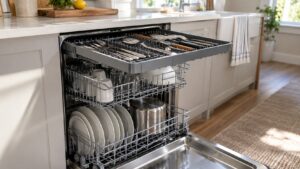
A Samsung dishwasher that keeps tripping the same error code or leaving dishes dirty puts every owner at the same crossroads: fix it again or replace it. The right call depends on the machine’s age, what’s actually failing, and whether the repair addresses the root cause or just the symptom. This guide walks through the factors that matter most before you decide.
Start with the error code, not the symptom
Samsung dishwashers (DW80 series) display two-character alphanumeric codes that point to a specific subsystem rather than a vague “it’s broken.” 4C or 4E means the unit isn’t detecting incoming water at the supply valve. 5C or 5E points to a drain restriction, often a clogged sump or blocked drain hose. 3C flags the wash pump or motor circuit, while 3E signals water has climbed above 176°F, usually a heater or thermistor problem. 7C/7E is specific to the WaterWall spray arm reflector not moving correctly, and 9C/9E means the unit isn’t reaching adequate water levels. bE or 6E indicates a stuck control panel button, LC or LE points to a detected leak, and HC or HE flags a heating circuit failure. Writing down the exact code before calling anyone narrows the diagnosis considerably and keeps you from paying to replace parts that were never the problem.
Weigh age against the failure
A dishwasher under five years old with a single error code — a clogged filter causing a 5C drain error, for example — is almost always worth repairing. These are mechanical, low-cost fixes. Once a unit passes the seven-to-nine-year mark and the control board, wash motor, or heating element is the actual failure point, the calculation shifts. Board and motor failures cost more to diagnose and replace, and a machine already showing its age in other ways (rust on the racks, worn door gasket, faded display) is a candidate for more failures soon after the first one is fixed. If you’re facing a second major repair within twelve months, replacement usually makes more financial sense over the appliance’s remaining life.
Consider what you’d be replacing it with
If your current unit lacks features you’d actually use, that’s a legitimate factor in the decision. Newer Samsung dishwashers with StormWash use rotating jets for a more aggressive cycle on baked-on messes, and WaterWall models spray from a bottom reflector rather than a fixed arm for better bottom-rack coverage. If your existing dishwasher is a basic model nearing the end of its service life and you’ve been wanting one of these features, replacement timing can make sense even if the current repair itself would be affordable.
Don’t ignore the small stuff
Plenty of “the dishwasher is dying” situations are actually maintenance issues: a filter basket packed with food debris, a spray arm with clogged nozzles, or mineral buildup on the heating element from hard water. These won’t throw a code every time, but they mimic bigger failures — poor cleaning, standing water, long cycle times. Before assuming you need a costly board replacement, pull the lower filter assembly and rinse it, check the spray arms spin freely, and run an empty cycle with dishwasher cleaner. It’s a five-minute check that resolves a surprising share of “should I replace this” calls.
Get a second opinion before you commit
If the code points to something beyond a filter or clog, get an actual diagnosis before deciding either way. A trained technician can confirm whether you’re looking at a low-cost part or a control board that costs more than a new mid-range unit. We’re an independent local appliance repair service, not affiliated with Samsung, and our dishwasher repair service can diagnose the code, quote the fix, and tell you honestly when replacement is the smarter move. For Samsung’s own troubleshooting reference, see Samsung Support.
This guide is provided by an independent appliance repair company and is not affiliated with, endorsed by, or sponsored by Samsung Electronics.