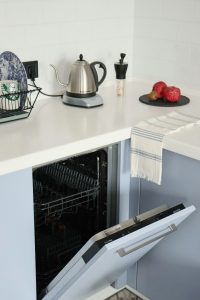
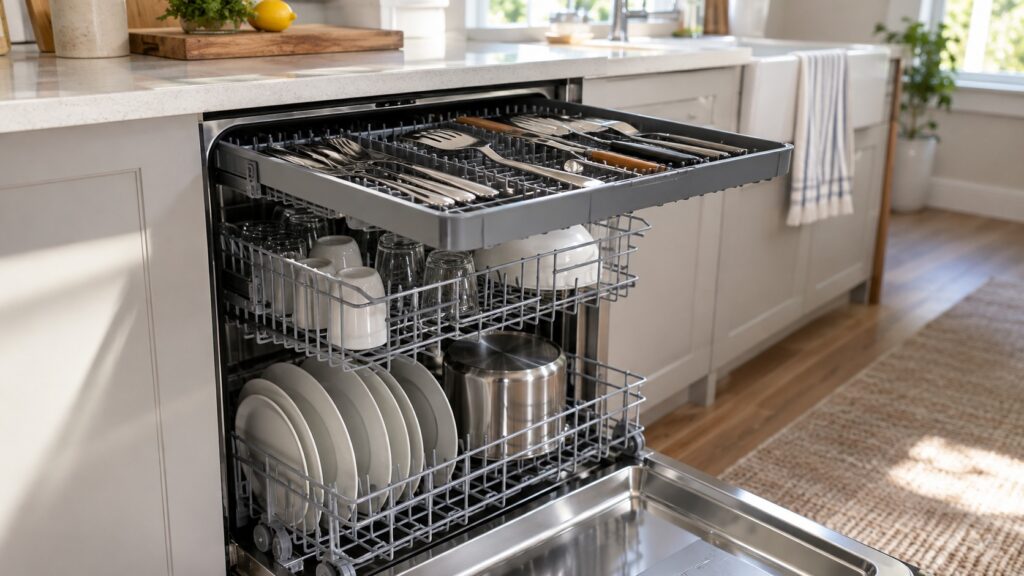
A third rack is the feature most likely to decide a dishwasher purchase and least likely to be examined before it does. The samsung dishwasher third rack is a shallow tray across the top of the tub for flat items, and whether it is a genuine gain or a daily irritation depends almost entirely on what it costs you in the rack below.
The trade you are making
A dishwasher tub is a fixed volume. Adding a rack at the top does not create space; it moves it. The upper rack drops, and the height available for glasses and mugs drops with it.
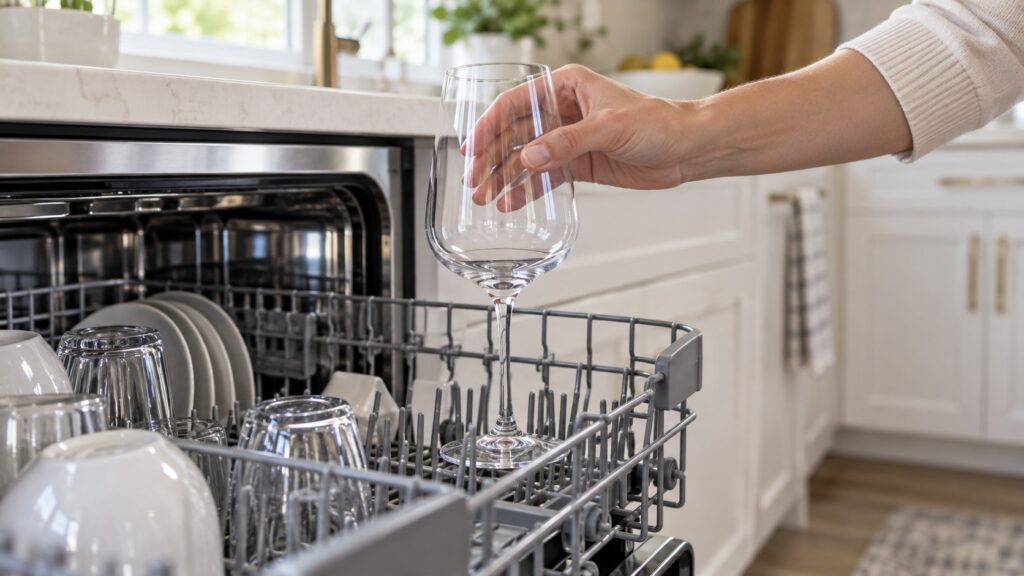
Whether that matters depends on what you own. A household with ordinary glassware rarely notices. A household with tall stemware, large travel mugs or a blender jug notices immediately and permanently.
The gain on the other side is real though. Moving cutlery out of a basket in the lower rack frees an area that previously held nothing but forks, and for most households that is a better use of the space than the height it cost.
What actually goes in it
- Flat cutlery — knives, forks, spoons laid flat rather than standing in a basket, which also washes them better.
- Serving utensils, spatulas, tongs that never fit anywhere sensibly.
- Small lids, measuring spoons, chopsticks and the things that fall through a lower rack.
- Espresso cups and small ramekins on racks that are deep enough.
What does not go in it: anything tall, anything heavy, and anything that blocks the spray arm mounted beneath it. Overloading the third rack is a common cause of poor cleaning in the racks below, because it becomes a roof.
Spray coverage, the question nobody asks
A rack at the top of the tub is furthest from the main spray arms. Some designs address this with a dedicated spray bar or additional jets; some rely on spray reaching it from below.
That difference shows up in results. A third rack without its own coverage cleans flat items adequately and struggles with anything with a recess. If you can, look at photographs of the tub with the racks removed and see whether there is a spray bar up there.
It is also why loading matters: items laid flat get cleaned, items stacked or overlapping do not. Our dishwasher troubleshooting guide covers the case where things are coming out dirty for reasons other than the machine.
Adjustability matters more than the rack itself
The single most useful feature in any dishwasher is an upper rack that adjusts up and down, because it is what lets the same machine take tall glasses one day and a stock pot the next.
Check whether that adjustment survives with a third rack fitted, and by how much. On some models the third rack is removable, which is the best of both arrangements — take it out for the load with the big pot, put it back for everything else. On others it is fixed, and the upper rack’s range is permanently reduced.
Fold-down tines in both racks matter for the same reason. A row that flattens turns a rack designed for plates into one that takes bowls or a tray.
Buying by your own inventory
Place settings are a poor guide and cycle counts are almost meaningless. What works is taking a mental inventory of your five most awkward items — the tallest glass, the largest pot, a baking sheet, a blender jug, the serving platter — and checking the racks against those.
If your awkward items are tall, the third rack may cost you more than it gives. If they are flat and wide, it costs you nothing and frees real space below. That is the whole decision, and it takes five minutes in a showroom.
Living with one, once it is installed
Two habits get the most out of a third rack and neither is obvious on day one.
Lay cutlery with handles alternating rather than nested. Spoons in particular cup together and the insides never get washed, which is the single most common complaint about flat cutlery loading and is entirely a loading problem rather than a machine one.
And unload the third rack first. Water pools in the recesses of anything in the top rack during the cycle, and opening the door tips it onto whatever is below. Working top to bottom keeps the lower racks dry, which matters more on a machine that dries by condensation than on one with a heating element.
What matters more than the rack
Three specifications affect daily life more than rack count does. Noise, quoted in decibels, decides whether you run the machine while people are in the room — and the scale is logarithmic, so a few points is very audible. Filter type decides your maintenance: a manual filter is quieter and must actually be rinsed. Drying method decides whether plastics come out usable.
Our care tips guide covers what a neglected filter does to results, and the maintenance guide covers the routine.
Measure the opening before you shop
Width is standard and that is where people stop. Height varies with modern models — third racks have pushed some machines taller — and a countertop that has settled over twenty years may not clear a nominally standard unit. Check depth if the machine sits proud of the cabinet run, and check the door swing against an island.
Our installation checks guide covers what the opening and the connections have to provide.
When to call
Call before replacing rather than after if the existing machine is under a decade old — filters, spray arms, drain pumps and gaskets account for most of what looks like end of life. Call for installation when connections or the electrical supply need work, and call when a machine will not drain, will not heat, or leaks.
We are an independent repair company and not a factory service arm. Pricing starts from a diagnostic visit and we confirm the estimate before any work begins. Samsung dishwasher repair covers pumps, valves, heating, doors and controls, and you can schedule a visit online.