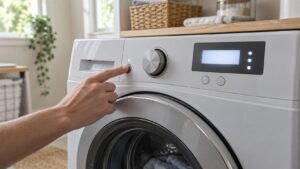
Samsung washers (WA top-load and WF front-load) are generally reliable, but the same handful of failures account for most service calls: fill problems, drain problems, and vibration during spin. Because the control board displays a specific error code for most of these, the first real diagnostic step is simply reading the display before you touch anything else.
Common Error codes and What They Usually Mean
- 4C / 4E / nF — the machine isn’t detecting water fast enough. Check that both hot and cold supply valves are fully open; nF specifically points to the hoses being connected backwards.
- 5E / 5C / nd — drain problem. A clogged drain pump filter or a kinked drain hose is the most common cause on both WA and WF models.
- Ub / UE / Ur — unbalanced load, usually solved by redistributing laundry, but repeat UE codes on an empty or balanced load can point to worn suspension rods or a leveling issue.
- dC / dE / dS — door or door-lock circuit failure, common on front-load WF units with a failing door lock assembly.
- SUd — oversudsing, almost always caused by using too much or the wrong detergent rather than a component failure.
- bE / 6E — a control panel button is stuck or shorted; try power-cycling before assuming a board issue.
- tE / tC — temperature sensor failure affecting hot fill or the heater cycle on models with an internal heater.
Symptoms Without a Displayed Code
Not every problem trips an error code. A washer that fills and agitates but never drains or spins may still show no code at all if the pump is only partially obstructed. Loud banging during spin on a front-load unit often traces to shipping bolts left installed after delivery, or to a worn spider arm on older units. A musty smell, especially on WF models, is typically biofilm buildup in the gasket and drum — not a mechanical problem.
What Homeowners Can Safely Check
- Confirm the water supply valves are open and hoses aren’t kinked or frozen.
- Check that the drain hose isn’t clogged and sits at the correct height per the installation manual — too high or too low can both trigger drain errors.
- Clean the drain pump filter (front-load models have an access panel low on the front).
- Verify the load is balanced and that leveling feet are still adjusted correctly on hard flooring.
- For SmartThings-connected models, check the app for a more detailed error description than the panel alone provides.
Front-Load vs. Top-Load Quirks
Front-load WF machines are more prone to gasket odor and dC/dE door failures simply because of the sealed drum design, while top-load WA machines more commonly show UE unbalance codes since the drum spins on a different suspension system. Impeller-style WA models (no center agitator) can also throw a code that looks like a load-size or fill issue when it’s actually a load that’s too small for the machine to distribute evenly — try adding a towel or two rather than assuming a problem.
When to Call a Technician
Recurring UE codes with a balanced, moderate load usually mean a worn suspension component, not user error. A dC/dE code that persists after confirming the door is fully latched points to a failing door lock switch. Any code involving the heater (HC/HE) or repeat voltage codes (9C1/9E1/PF) should be diagnosed rather than guessed at, since they can involve wiring or the main control board. A drain pump that runs continuously without actually clearing water, even after the filter is cleaned, usually means the pump motor itself is failing rather than being obstructed. If you’re working through a Samsung washer error code and it isn’t resolving with the basic checks above, our washer repair service can diagnose the exact cause, and our washer error code reference covers the full list with more detail.
We are an independent appliance repair service and are not affiliated with Samsung.