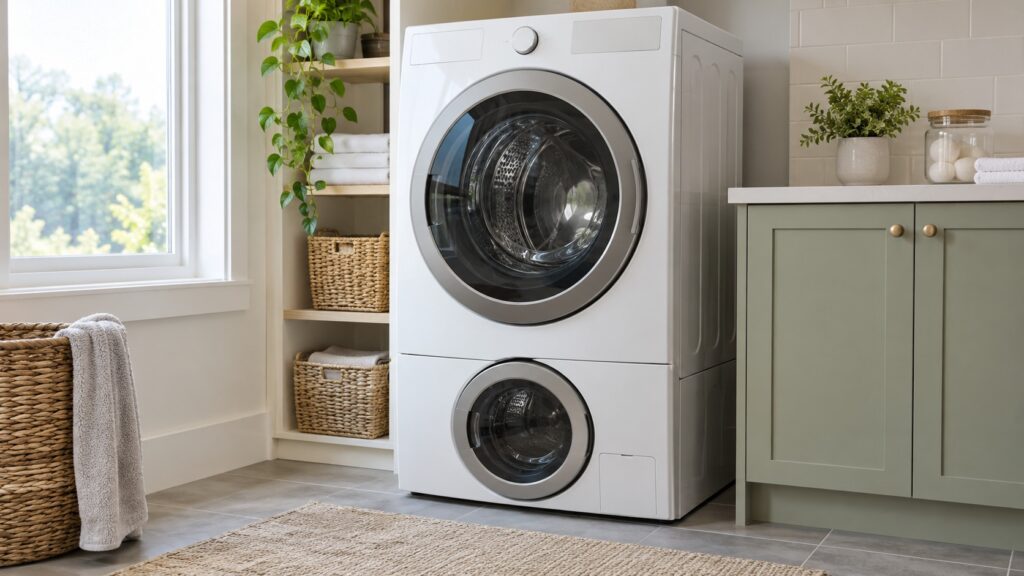
Samsung FlexWash is a washer system that pairs a full-size front-load washer with a smaller companion washer built into the pedestal, so two loads can run at once with different settings. On this site the WA and WF series are the top-load and front-load washers, and the WV60M9900AV is the FlexWash model in our model library. A Samsung FlexWash washer suits a household that does laundry in small separate loads all week. It is a poor fit if you want the simplest machine with the fewest parts to look after.
What is a Samsung FlexWash washer?
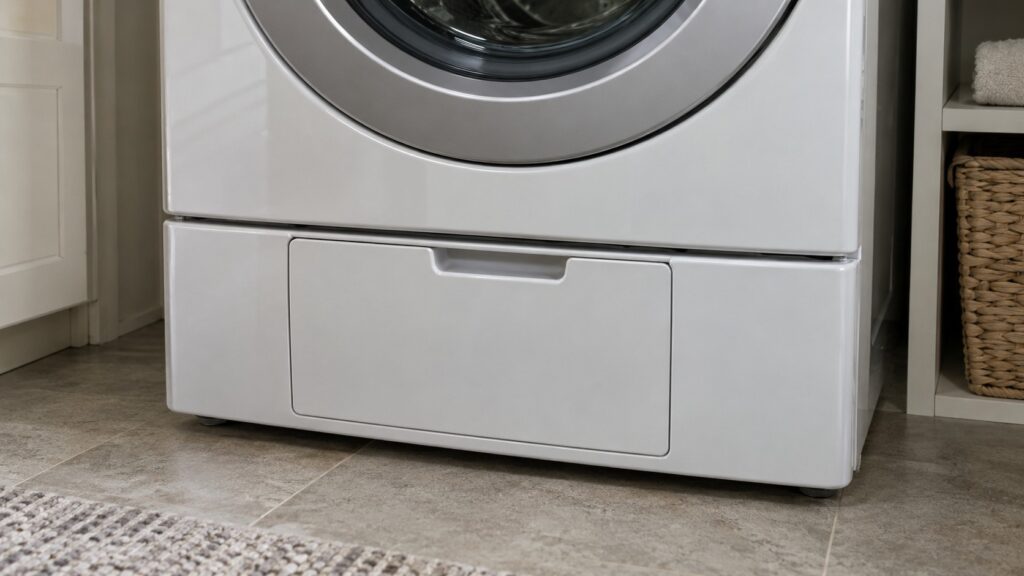
FlexWash is Samsung’s name for a two-compartment washing system. The top machine is a normal full-size front-load washer, and underneath it, in the pedestal where many washers keep a storage drawer, sits a smaller second washer. Each has its own door and runs its own cycle, so you can wash a delicate small load in the lower drum while a family-size load runs above it. Our washer overview describes it as found on select combo units, and our service pages list FlexWash front-load machines among the washers we repair. Our overview describes the lower unit as a companion washer, not a dryer, so plan on a separate dryer.
Who should buy a FlexWash washer?
It makes sense when your laundry is made of small separate loads: school or work clothes that should not meet towels, baby items, gym clothes, a few delicate pieces. It also makes sense in a household where waiting for one machine to finish is the bottleneck, since two loads can be going at once. If you wash one big load a day, a standard WF front-load or a WA top-load will do the job with fewer parts. The same is true if you want the machine to be as simple as possible to repair, since a second drum means a second set of parts and sensors.
What should you check before you buy one?
Start with the numbers that this site does not publish and that you should read off the model’s spec sheet and installation sheet: the capacity of each drum, the overall height with the pedestal, the clearances at the sides and back and the water and drain requirements. Because the second washer is built into the pedestal, check the overall height, any shelf above it and the door swing of both doors, with a tape measure. Check the floor too. Our Samsung model library lists the WV60M9900AV under the Bespoke series, and you can compare it with the other washers in the Samsung washers overview. Finally, think about drying: two washers can finish loads faster than one dryer can keep up with.
What goes wrong on a FlexWash, and how is it fixed?
The codes are the same family as other Samsung washers. On this site the codes you are most likely to meet are 4C for a supply that is restricted or an inlet valve that is not filling, 5C for a drain problem, dC for a door that cannot confirm it is latched, Ub for an unbalanced load, LC for a leak in the base area and 8C for the vibration sensor. The code page for the WV60M9900AV also lists 1C, bE and OC. FlexWash adds one thing: the second drum has its own sensors, and our washer repair page says technicians treat the two compartments as separate diagnostic paths rather than assuming a shared cause. In practice that means a fault in one drum does not automatically mean the other one is affected, and it is worth telling the technician which compartment showed the problem. For the most common one, our guide to the Samsung washer dC code shows what to check first.
How do you keep a FlexWash trouble-free?
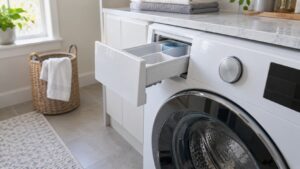
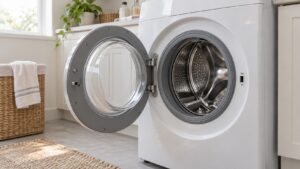
The habits are those for any Samsung front-load, applied twice. Leave both doors cracked after each cycle so the boots dry out, because a front-load that stays damp is the biggest cause of musty smells. Use only HE detergent, because other detergent creates suds that can trigger a SUd code. Clean the detergent drawer every few weeks and keep loads balanced rather than washing a single heavy item alone. Run the Self Clean+ cycle roughly once a month, as our Samsung Self Clean+ guide describes, and check how your model applies it to the lower drum in the owner’s manual, since the details differ by model. More everyday habits are in our Samsung washer care tips.
Is a FlexWash worth repairing when it gets older?
The general rule for Samsung washers applies: single-part faults such as a water valve, a drain pump or a door lock are cost-effective repairs on a machine under about 8 to 10 years old, while repeated motor or control board failures on an older machine make replacement more sensible. A FlexWash raises the stakes a little because there are two drums to keep in good order and a repair may involve more labor. A part swap is usually far cheaper than a new unit, but ask for a diagnosis that names the failed part before you decide, and read our Samsung washer repair or replace guide. Our Samsung washer repair page explains how a visit works.