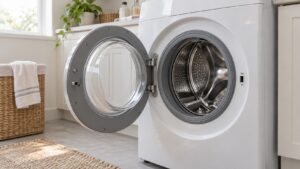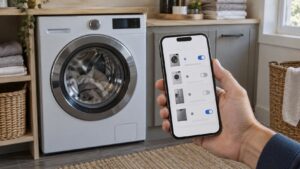
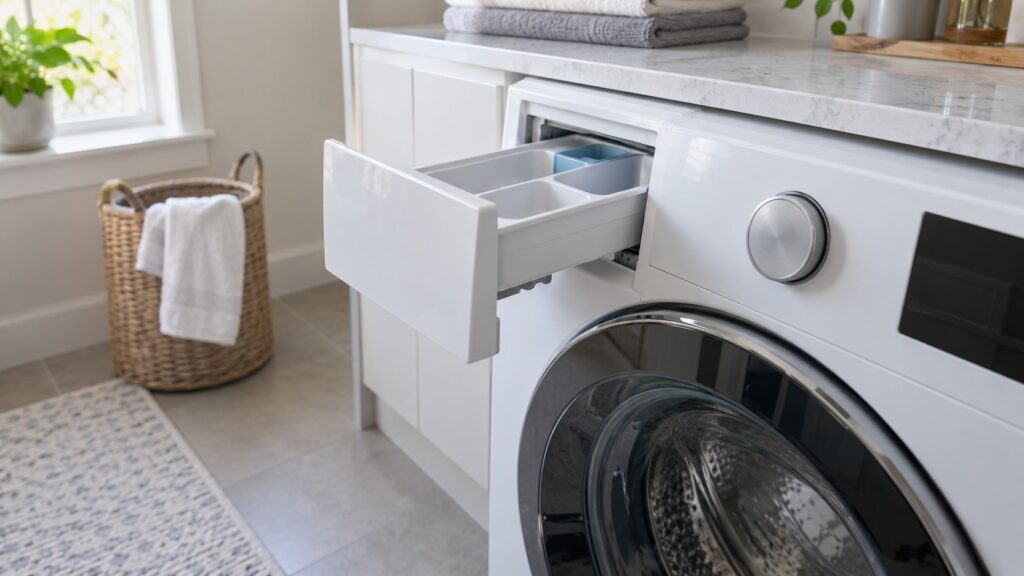
Samsung washer AutoFill is a feature name that this site lists on the WF45B6300AW, WF50BG8300AV, WF53BB8700AT and WF53BB8900AD, without describing how it works. The name alone does not tell us what it covers, so we do not claim a function for it. What AutoFill does on your exact model, and any setting that goes with it, is in your owner’s manual, and that is the source to trust. This guide explains in general terms how a washer fills during a cycle, the habits that help it do its job, and what to check when a washer fills too little, too much or not at all.
What is Samsung washer AutoFill?
The honest answer starts with what this site knows. It names AutoFill as a feature of four Samsung washers and does not describe its settings or its behavior. Samsung’s own manual for the model is the only reliable place to read what the name covers on your machine. In general terms, a modern washer fills itself in two ways: it lets in water according to the cycle and the size or weight of the load, and it moves detergent and additives from the drawer into the drum at the right moments. We will not claim that AutoFill is either of these, or which of them it relates to, how much water it uses or what any display symbol means, because we cannot confirm it from the pages we have.
Check the manual’s section on the detergent drawer and the cycle controls; the feature will be described there along with any option to turn it on or off.
It also helps to write down the exact model number and the feature name before you contact anyone about a filling problem. A technician can then look up the right manual and tell you whether the behavior you describe is part of the design or a fault, instead of both of you working from guesses about what an automatic feature should do.
How does a front-load washer fill during a cycle?
When a cycle starts, the washer opens its water inlet valves, and water flows through the detergent drawer into the drum. The control watches the water level and the load and decides when to stop. During the wash and rinse stages, the washer brings in more water and drains it. This is why a washer sounds different at each stage. Because the valves, the drawer and the level sensing are all involved, problems at any of them show up as filling trouble: slow fill, no fill, a drawer that does not flush or too much suds. The control relies on correct detergent use too, since too much detergent produces suds that the washer treats as water and responds to.
How do you get the best results from the fill stage?
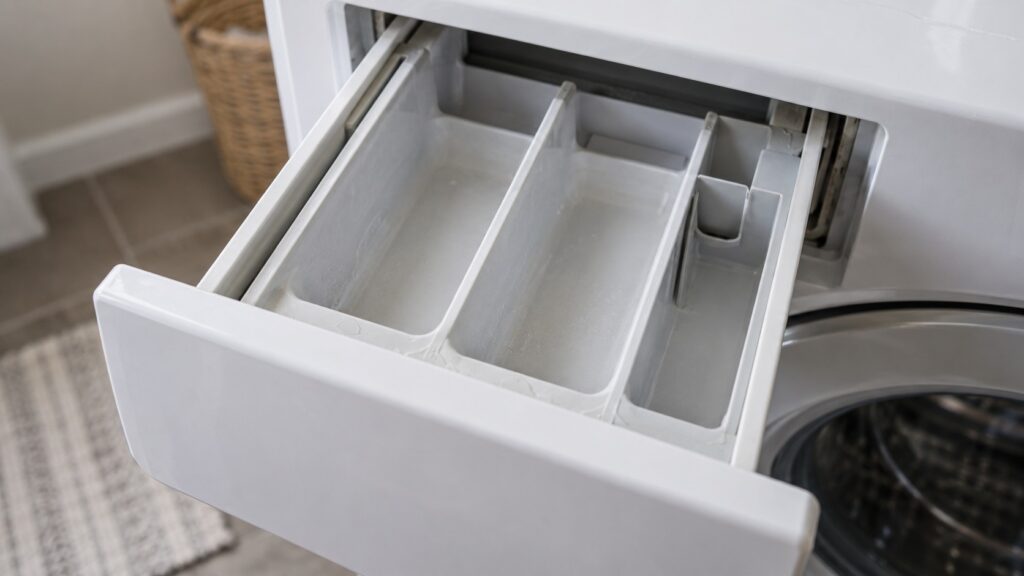
Four habits matter most. First, use detergent made for front-load washers, labeled HE, and in the amount your manual and the detergent label recommend. Our guide to maintaining a Samsung washer notes that too much detergent, even HE detergent, is the leading cause of oversudsing and leaves residue that feeds odor. Second, do not fill the drawer above its maximum mark, because overfilled compartments can let detergent flush into the drum too early. Third, load the drum normally; stuffing it can disturb the load reading. Fourth, keep the drawer and its cavity clean, since caked residue can block the flow of water through it. Wash the drawer and its cavity with mild soap and warm water, as your owner’s manual shows.
What if the washer fills slowly, too much or not at all?
Work from the outside in. Check that both water taps are fully open and that the supply hoses are not kinked or crushed behind the washer. A tap that is partly closed or a kinked hose slows the fill. Check that the drawer is pushed in fully. Look at the load: very dense or very small loads can change how the washer judges the fill. Check for suds in the drum, which suggests too much detergent; run a rinse and use less next time. If the washer stops with a code, our Samsung washer error code diagnostics and the Samsung washer troubleshooting guide list the code families.
Do not open the washer or reach behind panels to look at the inlet valves. They are connected to mains water and wiring. If you see water leaking near an outlet or the cord, switch off the breaker at the panel while standing on a dry floor and do not pull a plug from a wet outlet.
When should you call a technician?
Call when the washer does not fill even though the taps are open and the hoses are clear, when it overfills or leaks, when the same code returns, or when the drawer floods or does not drain. Take a note of the model number, the code and when the problem happens. Our Samsung washer care tips list habits that prevent many calls, and our washer repair page explains how a visit works.