Modern washers can tell you a great deal about themselves, and most people never ask. A samsung washer self test is the machine’s own routine for exercising each function in turn — fill, drain, heat, tumble, spin, door lock — and reporting what it finds. Used properly it turns a vague complaint into a specific one. Used carelessly it is a way to lock yourself out of a working appliance.
Do the physical checks before the electronics
A diagnostic routine tells you which function failed. It does not tell you why, and in a washer the why is usually mechanical and visible.
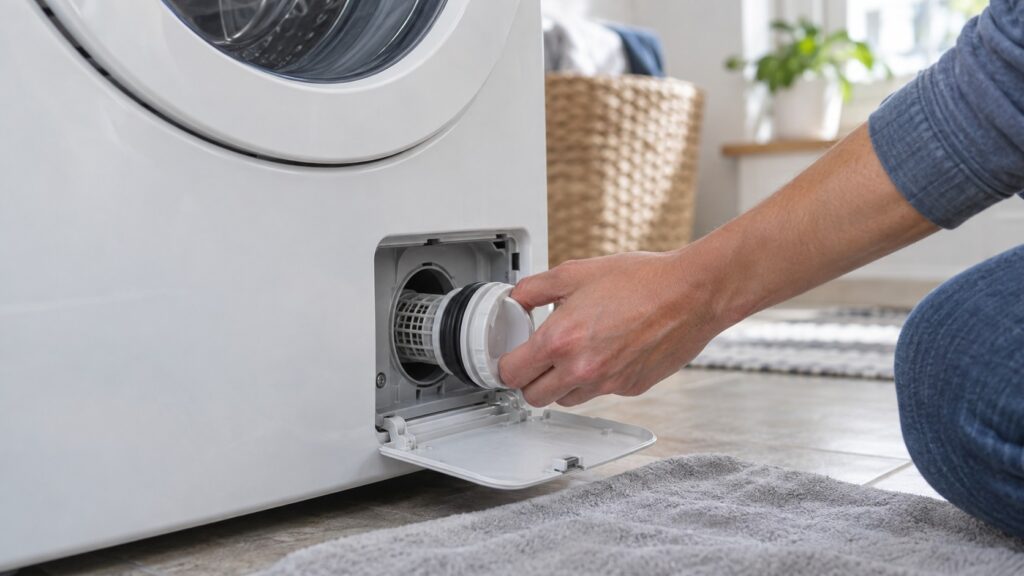
- Drain pump filter. Behind the lower front panel. A coin, a hairpin or accumulated lint here causes drain faults, long cycles and spin failures.
- Water inlet screens. Where the hoses meet the machine. Sediment here slows fill, and a slow fill reads as a fault.
- Door seal and latch. Laundry caught in the boot prevents locking, and the machine reports a door fault on a door that looks shut.
- Level and load. A machine not level, or a load that will not distribute, produces spin faults that no part explains.
Those four account for a large share of what people run diagnostics to find. Our washer troubleshooting guide covers them in detail.
What a self test actually does
The routine runs each subsystem in a defined order. It opens the inlet valves and checks water arrives at the expected rate. It runs the drain pump and checks the level falls. It locks the door and reads the confirmation back. It turns the drum and reads the motor’s position sensor. It runs the heater and watches the temperature climb.
At each step, it either proceeds or stops with a code. The code is useful, and so is the position it stopped at — a routine that fails at the fill stage and one that fails at the spin stage are pointing at completely different halves of the machine.
The routine is also destructive of your time: it will fill the drum, so the machine must be empty, connected and able to drain before you start.
Entering it, and why we are not printing a key sequence
The button combination differs between models, and it differs between production runs of the same model. A sequence found on a forum for a machine that looks like yours is as likely to enter a different mode as the one you wanted — and some of those modes change settings rather than test them.
Find your model number first. It is on a plate inside the door opening or on the rear panel, and it is what identifies the correct documentation for your exact machine. Then use the procedure for that model, not for a machine with a similar front panel.
If the machine is already showing a code without any mode being entered, that is better information than a self test would give you, and our washer error code diagnostics guide covers reading it.
Reading the result usefully
Write down three things: the code, the stage it stopped at, and whether the same result repeats. Repeatability is the most valuable of the three. A fault that appears every time is a component; a fault that appears sometimes is a connection, a sensor at a margin, or a mechanical condition that comes and goes.
Then map the stage to the likely area. A fill fault points at valves, screens, pressure sensing or household supply. A drain fault points at the pump, the filter or the hose. A door fault points at the latch, the interlock or its wiring. A spin fault points at balance, the motor, the belt on machines that have one, or the bearings. A heat fault points at the element, its sensor or its control.
What the routine will not tell you
It tests function, not condition. A machine that passes every step can still have worn bearings, a drum that is slowly going out of balance, a door gasket that leaks under load, or a pump that works on a test and struggles on a full load of water and detergent.
It also cannot see the household. Low water pressure, a drain shared with a sink that backs up, and a circuit that dips when something else starts are all outside the machine and all produce faults inside it.
One more limit is worth knowing before you spend an evening on it. A self test runs each part briefly and alone, with an empty drum and no detergent. Real cycles run them together, hot, wet and loaded, for an hour or more. That is why a machine can pass every step in the morning and stop mid cycle the same afternoon: the failing part works cold and fails warm, or works unloaded and stalls under a full basket of wet laundry. A passed test narrows the list. It does not clear the machine.
And it says nothing about the thing people most often actually want to know — whether a repair is worth doing. Our repair or replace guide covers that separately.
Before you call, gather this
The full model and serial number. The code, written down exactly as shown. What the machine was doing when it appeared. Whether it repeats. Whether the filter and inlet screens have been checked. And whether anything changed recently — a move, a new detergent, plumbing work in the house.
That set of facts frequently identifies the likely part before anyone opens the machine, which makes the visit shorter and the estimate firmer.
When to call
Call when a code repeats after the physical checks, when the machine will not complete a cycle, when it leaks, when the drum will not turn by hand, or when it is making a noise that has been getting worse rather than appearing suddenly.
We are an independent repair company and not a factory service arm. Pricing starts from a diagnostic visit and we confirm the estimate before any work begins. Samsung washer repair covers pumps, valves, motors, door locks and controls, and you can schedule a visit online.