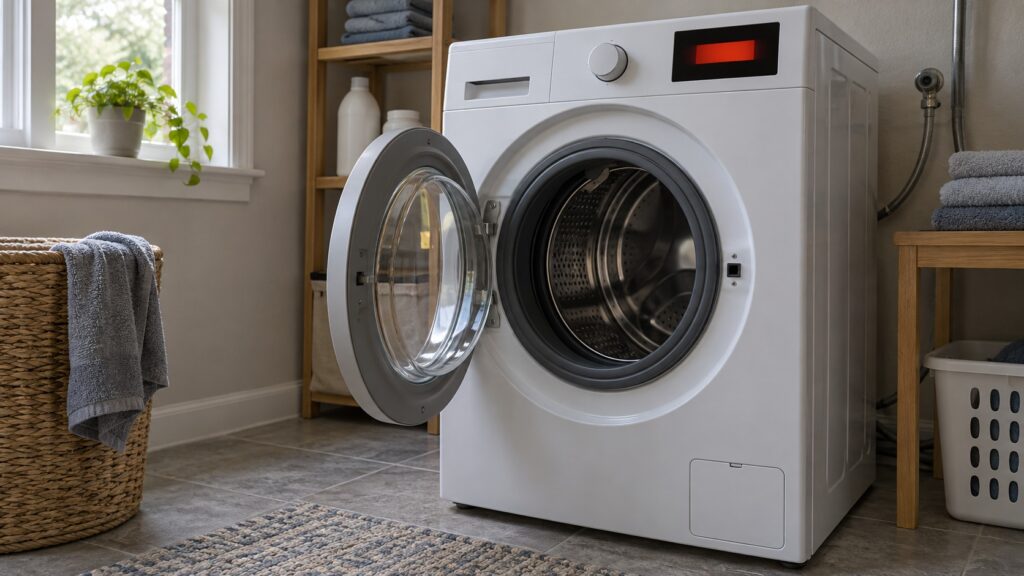
A Samsung washer that flashes dC has not failed a wash — it has refused to start one. The samsung washer dc code means the control board cannot confirm that the door or lid is fully closed and latched, and the machine will not fill, spin or unlock until that confirmation arrives. On this site the code page states it plainly: the door is not locking, closing, or reporting position correctly.
What does dC mean on a Samsung washer?
Every Samsung washer treats the door as a safety interlock rather than a convenience. Before the valve opens, the board asks the lock assembly a simple question: are you latched? The lock answers through a switch, and the answer travels back on a small harness. If the answer is no, or if no answer comes back at all, the cycle stops and dC appears.
That is why the code shows up in three very different situations that look identical on the display. The door may genuinely be open a fraction. The door may be shut while the latch has failed to engage. Or the door may be shut and latched while the switch or its wiring fails to say so. All three produce the same three characters.
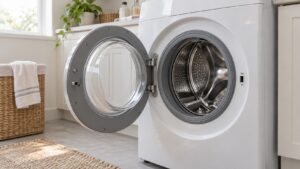
The practical consequence is that dC is not automatically a parts job. On a Samsung front load washer the single most frequent cause is a shirt sleeve or a towel corner trapped between the door glass and the boot seal, holding the door a hair out of square.
What should I check first when dC appears?
Work from the outside in, and do it with the machine idle rather than mid cycle.
- Open the door and look at the seal all the way around. Run a finger along the inside lip. A single trapped sock corner is enough.
- Look at the load itself. An overfilled drum pushes laundry against the glass, which pushes back against the latch.
- Close the door deliberately. Not a swing, not a nudge — a firm push until the latch clicks. Many dC reports end here.
- Run a cycle with the drum empty. If it locks and fills, the fault was mechanical interference and not electrical.
- Power the washer down for a full minute. Pull the plug rather than using the power button, then restore and retry once.
If dC returns on an empty drum with a door that clicks properly, the trouble has moved past housekeeping and into the lock assembly itself.
How do I inspect the latch and the strike?
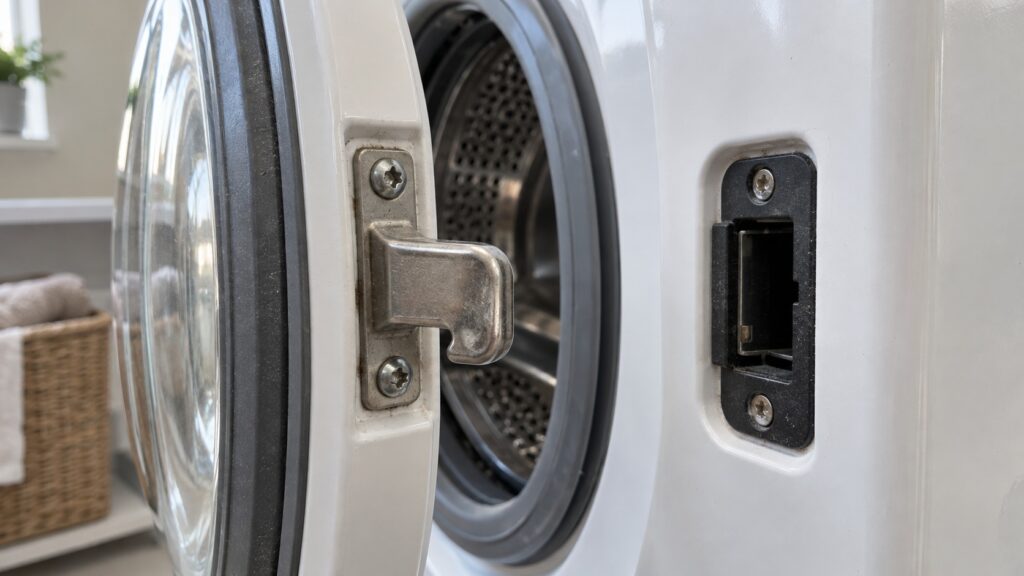
The parts involved are small and easy to read once you know where to look. On a front load Samsung the strike is the metal hook on the door; the lock assembly sits in the front panel behind a rectangular opening. On a top load the lid switch and its striker sit at the rear of the opening.
With the machine unplugged, look at the hook. It should be straight, square and unworn where it meets the lock. A hook that has been bent by a door slammed against a full drum will slide into the lock without seating. Look then at the opening in the panel: a loose tongue, visible debris, or a lock face that sits proud of the panel all point the same way.
Press the hook gently into the opening by hand and listen. A healthy lock gives a distinct mechanical click. A lock that has lost its solenoid or its spring gives a dull, soft resistance and nothing else.
Stop there. The lock assembly carries line voltage and sits directly behind the front panel, and on a machine that stopped mid cycle the drum may still hold water. Removing a front panel to reach it is not a job to start on a hunch.
How is dC different from 4C, 5C and UB?
Samsung uses short codes that look alike on a small display, and picking the wrong one sends you to the wrong part of the machine. The distinction is worth holding in mind before you order anything.
- dC is about the door reporting its position. Nothing to do with water.
- 4C is about water not arriving as expected — supply, valve, or hose.
- 5C is about water not leaving — the drain path and the pump filter.
- UB is about an unbalanced load, which stops a spin rather than a start.
Because dC and UB both interrupt a cycle that had been running normally, they get confused constantly. The tell is simple: a UB stop leaves the door unlocked and the drum free, while a dC stop leaves the machine unwilling to begin at all. Our Samsung washer error code diagnostics guide lays out the full set, and the individual dC code page carries the affected components.
Why will the door not open while dC is showing?
This is the part that worries people most, and it is the part that is working correctly. When a Samsung washer stops with water in the tub, it keeps the door locked on purpose. Releasing the lock would put several gallons of water on a kitchen floor.
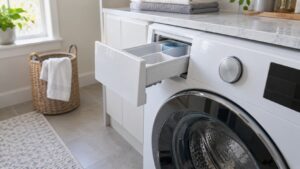
The right sequence is to drain first, not to pull. Nearly every Samsung front load washer has a small access hatch at the lower front containing the pump filter and a short drain hose with a cap. Put a shallow pan and a towel down, pull that hose, release the cap slowly, and let the tub empty. Once the water is out, the lock will usually release on its own or after a power cycle.
Prying at a latched door bends the hook, and a bent hook turns a five minute drain into a lock replacement. If the hatch hose will not drain either, the machine has a drain fault sitting underneath the door fault, and the Samsung washer troubleshooting guide covers that path.
Can the washer tell me more about the fault?
It can, within limits. Samsung washers carry a service test that steps through the lock, the valves, the pump and the motor in sequence, and it will exercise the door lock on command. Watching whether the lock fires at all separates a dead assembly from a reporting problem.
What the test will not do is tell you which of the two halves failed — the lock or the switch that reports it. That needs a meter on the harness with the panel off. Our guide to Samsung washer self test mode explains what the routine covers and what it leaves out, and it is worth reading before you take anything apart.
When is it time to call a technician?
Call when dC returns on an empty drum with a clean seal, when the latch no longer clicks, when the door stays locked after the tub is drained, or when the code appears together with a burning smell or a tripped breaker. Those last two are electrical and should not wait.
We are an independent repair company and not a factory service arm. Pricing starts from a diagnostic visit and we confirm the estimate before any work begins. Door lock assemblies are among the less expensive Samsung washer parts, and the job is usually a single visit. Samsung washer repair covers locks, harnesses, boards, pumps and seals, and you can schedule a visit online.